

The Great Tech Reversal: My Financial Times op-ed
"The diffusion of technology between China and the West is increasingly a two-way street."

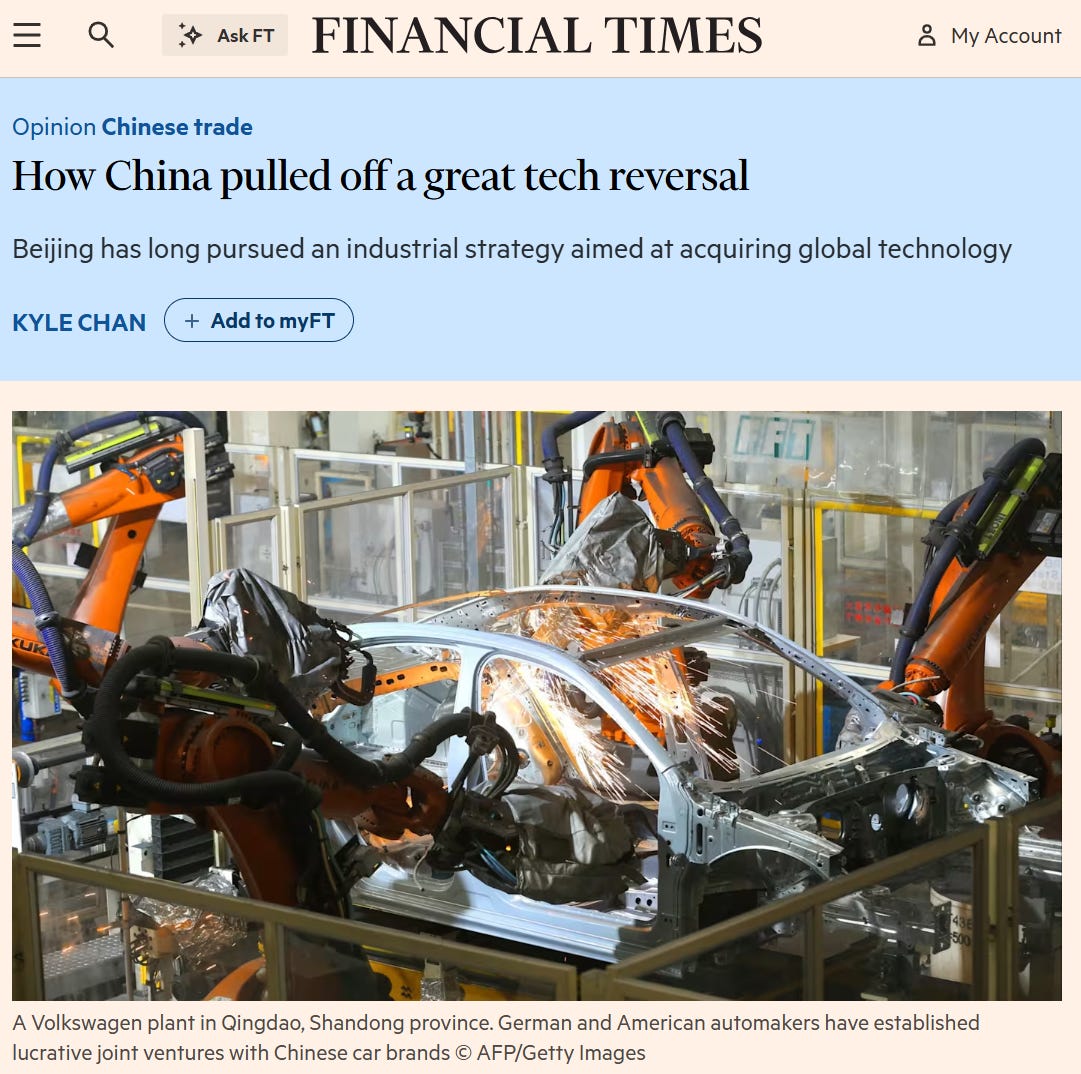
My Financial Times op-ed begins:
“We are witnessing a great reversal in global technology flows. For decades, China lagged behind the west. American and European companies sold products to Chinese consumers and set up factories in the country, lured by its vast market and low labour costs. Apple and Tesla built mega-factories in cities like Zhengzhou and Shanghai. GM and Volkswagen established lucrative joint ventures with Chinese automakers.”
“But the diffusion of technology between China and the west is increasingly a two-way street. Across a growing array of products — electric vehicles, batteries, drones, rare earth magnets — it is now China that stands at the global frontier.”
Read the full piece here:
How China pulled off a great tech reversal
Related pieces I’ve written for High Capacity:
Kyle Chan’s analysis of reversing global technology flows captures a genuine shift in the international political economy. For decades, technology transfer largely moved from firms in Europe and North America toward China. Today, as Chan shows, that direction has reversed across electric vehicles, batteries, biotech, robotics, and artificial intelligence. Companies such as Volkswagen, Ford, and Meta increasingly license Chinese technologies, partner with Chinese innovators, or acquire Chinese-founded start-ups. Chinese firms have moved upstream in global value chains, reshaping innovation hierarchies.
The weakness in the analysis lies not in the evidence, but in the theoretical frame used to interpret it. By presenting these dynamics as interactions between “the West” and China, Chan relies on residual assumptions from liberal institutionalism and realism that presuppose coherent geopolitical blocs. That binary lens no longer describes how power operates.
The Liberal International Order does little explanatory work here. Multilateral regimes no longer discipline behaviour, institutions struggle to coordinate policy, and most-favoured-nation principles have been eroded by sanctions, export controls, and industrial policy (Farrell and Newman 2019). Technology flows are no longer structured by a rules-based order but by selective, bilateral arrangements shaped by regulatory and security concerns.
Realism performs no better. States do not monopolise control over innovation or diffusion. As Susan Strange (1988) argued, structural power resides in markets, production systems, finance, and knowledge rather than formal sovereignty. Firms, capital markets, and regulatory jurisdictions increasingly determine access and sequencing. The Manus acquisition illustrates this dynamic. Its relocation from China to Singapore was not geopolitical defection but jurisdictional navigation to maintain access to US capital and markets. Similar logic applies to firms such as HeyGen and Shein, which have restructured ownership and headquarters to mitigate regulatory risk.
What is emerging is not a bipolar contest, but a fragmented system of jurisdictional engineering in which domicile, data localisation, and ownership structure matter more than bloc loyalty. China’s tightening of export controls on batteries, rare earths, and AI mirrors earlier US practices, signalling not rupture but normalisation as technological advantage accumulates (Aggarwal and Reddie 2021).
The reversal Chan describes is therefore not simply a shift from West to East. It reflects a deeper structural transformation in which global technology flows are governed by dispersed sovereignty and market-mediated power. Analyses that retain bloc-based assumptions risk misreading how innovation and competition now operate.
Bibliography
Aggarwal, V. K. and Reddie, A. W. (2021) ‘New Economic Statecraft: Industrial Policy in an Era of Strategic Competition’, Issues & Studies, 57(2), pp. 1–29.
Farrell, H. and Newman, A. L. (2019) ‘Weaponized Interdependence: How Global Economic Networks Shape State Coercion’, International Security, 44(1), pp. 42–79.
Strange, S. (1988) States and Markets. London: Pinter.