

NEW podcast: China's robotics and industrial automation with Georg Stieler
The first episode of the new High Capacity podcast

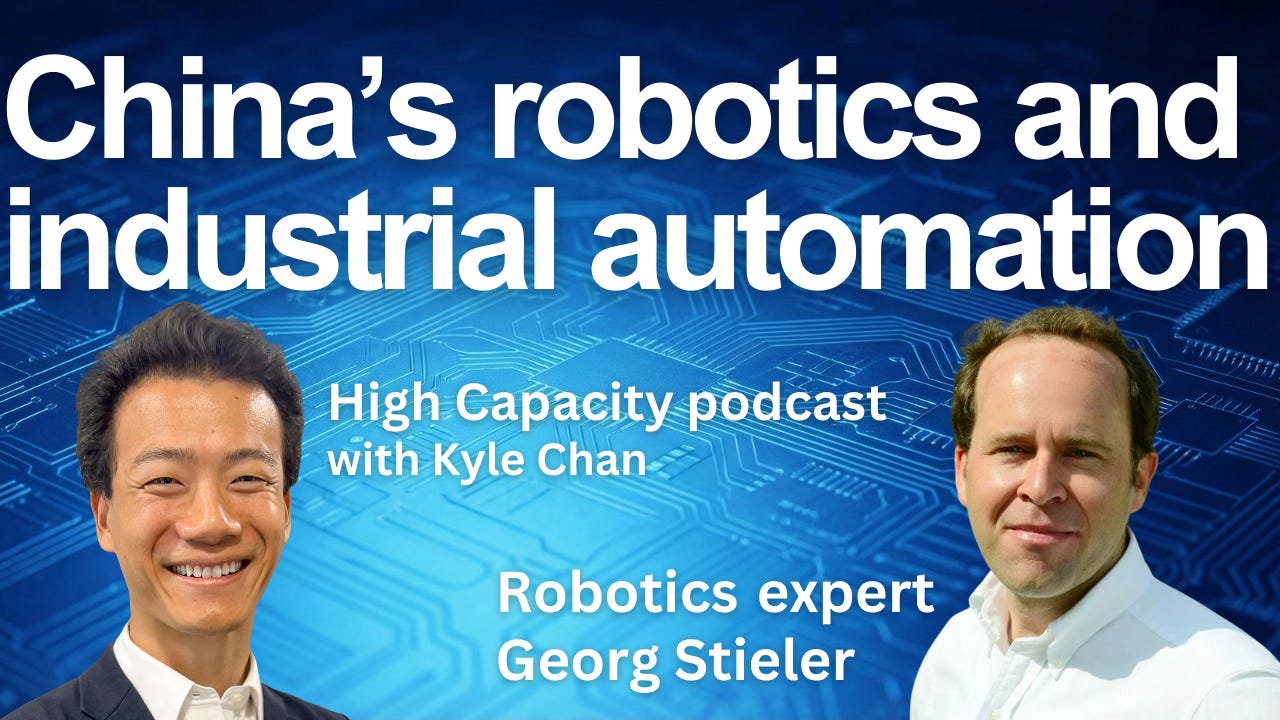
I’m excited to launch the new High Capacity podcast, focused on technology in China. The podcast will feature in-depth interviews with experts on what’s happening in China with AI, robotics, EVs, clean tech, biotech, and more.
Watch or listen to the High Capacity podcast on:
In this episode, I speak with Georg Stieler, Asia Managing Director and Head of Robotics and Automation at Stieler, a global technology consulting firm. He’s a leading expert on robotics in China with over a decade of experience based in Shanghai.
Key takeaways:
Know-how for robotics applications is now flowing from China to the West. Previously, Western and Japanese firms brought automation expertise to China. But now this flow of knowledge has flipped, especially EVs and batteries.
China’s robotics market is also flipping. Made in China 2025 was a huge market opportunity for foreign robotics firms. But now they’re being challenged by Chinese players who are moving into global markets.
Chinese robotics firms won in newer and simpler segments first like “cobots” (collaborative robots) and mobile robots, then moved up the industry ladder. The pandemic gave Chinese firms an opportunity to gain market share.
The EV and electronics industries caused a step-change in the pace of production. Chinese manufacturers have accelerated development cycles, driving an acceleration in the global auto industry.
Humanoid robots are part of China’s push into “physical AI.” China has an edge in robotics supply chains. A crucial factor will be the development of vision-language-action (VLA) models that power the “brains” of robots.
Follow Georg Stieler on Twitter / X and LinkedIn
Georg Stieler’s recent publications:
The Robot Report: China experiences physical AI surge — and how the U.S. should respond
The Robot Report: CIIF 2024 shows major robotics trends in China
Transcript
Kyle (00:00)
Welcome to the High Capacity Podcast. I’m your host, Kyle Chan, a fellow at Brookings. And I’m thrilled to be joined today by my guest, Georg Stieler, a leading expert in robotics with extensive industry experience working on robotics in China. He is the Asia Managing Director and Head of Robotics and Automation at Stieler, a global technology consulting firm headquartered in Germany with branches in China and Switzerland. He has spent over 10 years based in Shanghai and traveling all across China to work for some of the leading international robotics companies. Welcome, Georg, and thank you for coming on the show.
Georg (00:39)
Hi Kyle, thank you very much for the invitation, happy to be here.
Kyle (00:43)
Great, so I thought it would be useful to start just with your background. If you wouldn’t mind sharing your experience working in the industry, your experience working in China—you’ve had a long career, really in the details, on the ground, working with clients, working in factories, seeing how this is playing out in real time. So yeah, I just thought, if you wouldn’t mind sharing some of your background in this area.
Georg (01:11)
Yeah. So my first encounter with China for a longer period was actually as a student at Tongji University in 2007 for an exchange year. And after graduation, I first worked as assistant to the CEO of a German renewable energy company. And then after doing that for almost two years, my father asked me if I wanted to do something in China. So I came back to Shanghai in 2010—first on a project basis—and this was so much fun being back that we decided to formally set up a branch office there and moved there permanently in 2011.
And yeah, I mean, our company has traditionally had a strong client base in everything that goes into mechanical engineering—things where Germany has been traditionally good at. And so we started relatively early to work with ABB Robotics. That was in 2012, the first project with them. And they wanted to develop the Chinese market more proactively. That meant we identified the 300 leading Chinese automotive component manufacturers, identified the people in charge for robotics and automation, and asked them what they were using already, what they were planning to purchase, and generated enough leads for ABB to keep their sales team busy for a year.
And we saw then that there was a wave of investment coming for robots at that time. And then we analyzed the whole industrial automation ecosystem in China very extensively. We wrote a large study that was almost 250 pages, and then we were very well placed within the industry to also win other clients.
So we continued working with ABB, helped them, for example, to specify the requirements for a new robot for the electronics industry. But we also worked with KUKA very closely for eight years. We advised Universal Robots and their mother company, Teradyne, on a China strategy during the pandemic.
And also, yeah, I worked for smaller companies in the periphery, like Schunk—they do robot grippers. And yeah, very exciting strategic questions: what are high-value applications for collaborative robots? How do robot applications change when the vehicle industry turns from internal combustion engines to electric?
And yeah, we also took the other perspective and helped companies like Bosch or Mercedes-Benz—or even Coca-Cola—to identify solution providers in the automation field and evaluate them.
Yeah, and then we also worked for American companies in this field who wanted to scout the Chinese market: an autonomous mobile robot company from Pittsburgh, which we then ended up supporting with their market entry in Europe, and also an AI startup from Palo Alto called Drishti. We also scouted China first with them, and then I helped them with their market entry in Europe. Then they were finally sold to Apple in 2023.
So we worked for a lot of different companies in this field and took multiple angles as advisors—and saw how China, from being a market that was lagging technologically, is now a leader in many fields.
Kyle (04:52)
Yeah, no, that’s fascinating. And it’s incredible—the range of different industries, types of applications, types of robots that you’ve worked on, types of clients, both on the supplier side and on the manufacturing side. And yeah, I was just kind of wondering if you might elaborate more on various trends that you’ve seen over time in your experience working in China. So, you know, whether it’s also the shift in the types of questions that you’re getting, the types of projects that clients are asking you for help with, or even the shift in the mix of types of clients.
And then also, I mean, feel free to touch on any of these things or pick and choose, but you mentioned, for example, the shift from internal combustion engine auto manufacturing to electric vehicles. And that must’ve been sort of a huge moment in terms of retooling, rethinking, supply chains, automation processes. So yeah, if you wouldn’t mind sharing some of these longer-term trends that you’ve seen, given your experience working in this space for years now.
Georg (05:58)
Yeah, one of the major changes is now that application know-how is flowing more westwards. Ten years ago, we had, of course, the large companies, but also some quite small and medium-sized automation companies from Europe—Germany, Switzerland, Italy—who wanted to sell into Made in China 2025. They saw this automation tsunami coming and they had these advantages of decades of more experience in automation.
So we also worked for four years—we ran the China branch for a small company with 60 employees. But what—
Kyle (06:37)
And that was a time when—oh, sorry—that was a time when Made in China 2025 for some companies was seen as an opportunity rather than purely a competitive challenge.
Georg (06:49)
Yeah, I mean, for the first couple of years, it was a huge chance for companies to double their revenue. But many underestimated how quickly China caught up, actually. So for many, this optimism changed to fear within just one decade.
Kyle (07:03)
Right.
Georg (07:12)
It also went quicker than I expected.
Kyle (07:16)
Hmm. Yeah, no, that’s interesting. Okay—so sorry I interrupted you, but you were sort of—
Georg (07:20)
And yeah, so—I mean, we can then continue: if we look at the market share of Chinese robot manufacturers, six years ago that was still below 30%. And now we are at 57%. And we’re only counting the local manufacturers there. This doesn’t take into consideration that ABB, KUKA, now also Universal Robots, Yaskawa—that they all manufacture in China.
So the initial goal of Made in China 2025 was to have a localization rate of industrial robots of over 70% by 2025. And we’re probably there when we take the foreign robots manufactured on-site into consideration for this number.
And then, yeah, of course—
Kyle (07:54)
Mm.
Georg (08:19)
Yeah, you mentioned the electronics industry. This is the electric vehicle industry—this is a field where China is just the global benchmark now. You cannot build a competitive battery manufacturing plant in Europe without Chinese know-how these days. So this is clearly something where we have manufacturing know-how coming from China.
Interestingly, it’s the same phenomenon that we saw with German companies going abroad for 40 years: they brought their own suppliers and helped them to globalize. And now when CATL builds a factory or BYD builds a factory in Europe, they bring their own robot manufacturers and system integrators.
Kyle (09:08)
Yeah, yeah—no, this has been a huge change, not just within China, but for the global auto industry. Yeah, actually sort of building on that: is there a large transformation that needs to happen when you’re making that shift from, say, internal combustion engine to EV production? Or are we talking about just brand-new factories? To what extent is it retooling, reconfiguring existing auto plants? And to what extent are you installing completely new robots, completely new systems—obviously dealing with, say, the battery components and battery management systems and things like that. How much of that is very, very new versus modifications to existing production?
Georg (09:56)
Changes for the car body are not so much, but for the whole drivetrain—that’s a major change because you have completely different applications, you have different parts, you have different weights.
A major difference there is also that you have a new set of players. When you’re a European company and one of your major competitive advantages was strong relationships into, say, the German car industry for decades—where it’s very difficult to get listed as a supplier there—and suddenly they are losing market share, and you have some new Chinese players which you barely know, then you need to change a lot.
Kyle (10:33)
Yeah, yeah—it’s a technological change, supply chain change, deep transformation across the industry, including the emergence of—
Georg (10:40)
Yeah—prices, they expect much faster deliveries, they expect more flexibility, faster product turnovers.
Kyle (10:52)
Yeah. Yeah. And in general—
Georg (10:52)
And yeah, this often has not been understood.
Kyle (10:55)
Yeah, yeah, yeah. That’s fascinating. And in general, the automotive industry is the largest user of industrial robots—at least historically. And so it matters a lot for robotic suppliers, both international and Chinese, that there’s this huge shift in the auto industry itself. Is that right?
Georg (11:17)
Also in that regard, China changed something because I think it was 2016 or 2017 when the electronics industry was actually the more important sales market than the automotive industry. And that drive came from China—when companies like Foxconn, or their local competitors like Luxshare, started to deploy robots at a larger scale.
Kyle (11:44)
Yeah,
Georg (11:44)
And that again came with different requirements: shorter payback cycles. Correspondingly, you need to bring them into operation much faster. When you know in March how the next iPhone generation will look, and then you want to start mass production by mid-June, you need to be much faster than people were used to from the automotive industry, where a model would run for seven years—and maybe with a facelift after three and a half years—you had much more time to do things in a diligent way.
Kyle (12:19)
Yeah. Yeah, yeah. I mean, it makes sense in many ways that the automotive industry will take its time. You know, there’s a really strong emphasis on quality and safety control. So, you know, perhaps a longer testing period, a longer development period.
But then I do wonder—to your point—to what extent did China’s experience with electronics manufacturing, like with iPhones, feed into its emerging EV industry? Including faster timelines, maybe different ways of doing production, different ways of organizing supply chains, different ways of even doing design and R&D. Do you see an overlap there—capabilities for one industry spilling over into another?
Georg (13:11)
Yes, of course. So development cycles for new cars shortened dramatically with the emergence of Chinese players—easily by half or even less.
Kyle (13:22)
Yeah, yeah. No, it’s been fascinating to see now some of the non-Chinese automakers try to speed up their timelines, right? So there’s an industry-wide effect, it seems, in some of these cases. And some of that might involve even R&D in China.
Georg (13:39)
Yeah, definitely. The interesting thing is that the permanent emergence of new car models—to keep customers interested—also creates a permanent demand for new industrial equipment. So when we expected that actually the car capacities had been built now, the demand continued for a while.
Kyle (13:54)
I see.
Georg (14:03)
Because new models require new lines with new production equipment as well.
Kyle (14:08)
I see. So this is sort of like a step change in the whole industry—the demands for automation, demands for robotics. It wasn’t just like a wave of installations and then it was done. It was like the entire pace of the industry has stepped up, and the demand overall for the suppliers for industrial automation has increased.
Georg (14:21)
Yeah. In certain fields you definitely have some saturation, but the permanent need for new product differentiation—at least for now—has created a relatively permanent stream for new industrial equipment as well.
Kyle (14:49)
Yeah, that’s super interesting. And then just to take a step back—looking across the broader industrial automation and robotics landscape—where do you see China making the fastest progress? Where are there certain areas—whether it comes to the traditional six-axis arms or cobots—we can get into humanoids later on—but are there certain areas where you see Chinese players really entering into the market fairly actively and becoming more competitive? And are there areas too where it’s been a slower evolution and maybe the global incumbents are still the main players?
Georg (15:39)
Yeah, so where Chinese players made the first easy inroads were price-sensitive fields where the high-quality benchmarks did not matter so much. Like one of the key measures, of course, is precision and reliability—mean time between failures. And this is critical in particular in the automotive industry.
When you have a robot breaking down and the line stops on a Friday afternoon, that can easily cost you a couple of million US dollars. So they are very picky in who gets in there.
And in collaborative robots, and also in mobile robots, the technological backlog was not so much. Collaborative robots is a segment that is only 20 years old. So Chinese players now have a market share of over 90%. The same in mobile robots—we have some very strong local players in this field.
And then also, when we look at the high-quality industrial robots, we have a couple of players that are also attacking the automotive industry now. And that started within the pandemic, when some of the leading international robot manufacturers had some supply problems. Then suddenly companies like BYD gave Estun, for instance—the local market leader—a chance. And they showed that they were good enough. And they provide this industry now with solutions that used to be reserved for the international top four—like spot welding, for instance.
And we also see that companies like Xiaomi, who are an investor in a company called Rokae, are trying to bring them to a level where they can use them for welding applications.
Kyle (17:34)
I see. I see. So they’re kind of working together—the Chinese customers and the Chinese robotic suppliers are working together.
Yeah, yeah. So, I mean, this pandemic story is so fascinating to me because you have this external shock to the whole system. You have a temporary sort of almost like embargo on what can really go back and forth in and out of China—or it makes it much more difficult to bring outside components, service technicians into China.
Would you mind just walking through—from the perspective of a BYD or any large manufacturer in China—I assume previously they would prefer to use established foreign brands for the robotics because they’re reliable. They may be more expensive; if it costs you millions of dollars on the production line when you have a failure, then it might be worth it. But then this shift to the Chinese players—yeah, if you wouldn’t mind elaborating more on what the logic there was, what the rationale was, and how the pandemic reconfigured the industry.
Georg (18:51)
It was not necessarily the movement of people—that was more in other fields of mechanical engineering or plant building. These were semiconductor constraints that didn’t necessarily originate in China.
What we saw were different ways to handle quarantine obligations—so that ABB did it less successfully than, for instance, KUKA or FANUC. ABB’s plant during the Shanghai lockdown in 2022 was basically not running for six weeks in a row, and the others were somehow able to operate.
If you start with 3C—the electronics industry—or continue this to automotive: I mean, one of the things is of course the price, but the other thing is delivery speed. Yeah, so this is a hit or miss in many regards.
And yeah, BYD is also not in the top premium segment. So probably that’s one of the reasons why they were more open to give a local manufacturer a chance. And they still work very closely with, for instance, also with KUKA. So it’s not exclusively with Estun.
Kyle (19:44)
Right.
Kyle (20:06)
Mm-hmm. Yeah, no, this is really interesting. So it’s been sort of opportunistic areas where cobots are newer and maybe don’t require quite the level of precision as a heavy industrial robotic arm for the automotive industry. Maybe some of those areas had seen greater progress for some of the Chinese players. But now even in some of those more difficult-to-enter segments, we’re starting to see Chinese companies move up.
Georg (20:38)
Yeah, I mean, take semiconductor manufacturing, for instance. There you need to fulfill clean room requirements. And this has become a very important market for Siasun—a company which is state-owned and which I never saw very successful in high volumes.
Kyle (20:44)
Mm.
Georg (20:58)
Yeah. Since this is a very strategically important industry for the government, they managed to fulfill the quality requirements for this industry and are selling very well into this now.
Kyle (21:15)
Yeah. So you mentioned a couple of these Chinese industrial automation and robotics companies. And I was wondering if there are any ones that you would like to highlight. So you mentioned Estun, mentioned Siasun, you mentioned some of these cobot players—there’s Inovance, for example, which has been in the news. Yeah, I don’t know if there’s any ones you want to highlight in terms of what they’re able to do, areas where they’re making interesting progress—yeah, which ones are the better ones or the stronger ones, or perceived to be so. And also if any of them have started to branch out beyond the Chinese market and do exports even to Europe, that would also be interesting.
Georg (21:56)
Now, Estun is clearly to mention in this context. This past year—2025—they were, by volume, the number one. Quite an achievement.
I remember we were working with a German company that actually built their production lines eight years ago. They kept calling me from time to time and asked me, “What’s your expectation for the robotics market in half a year?” because our customer doesn’t make any planning—they just say they want to scale as fast as possible. Yeah, we were laughing at that time, but success showed that they were right.
And they were not a state-owned company. They were not a favorite child of the government in the beginning. They have a very charismatic and driven founder who also seems to have a very clear strategy, which includes ambitious internationalization. So they made a couple of very valuable acquisitions. They acquired a motion control company called Trio in Europe. They acquired CLOOS from Germany already six years ago—at that time, CLOOS’s revenue was larger than Estun’s revenue. But the acquisition of Trio gave them the motion control capabilities to catch up with the traditional incumbents, and CLOOS gave them an edge in welding technology.
And all this is coming into play now. And yeah, they are now expanding all over the world—not so much to the US, but a lot to emerging markets and to Europe. I would say in robotics, it’s so far the only Chinese player who does it right.
They hired some very capable people from FANUC Europe and other competitors, which probably cost a lot of money, but also brings their network and attracts other high-profile salespeople.
And they built a factory in Poland. From time to time, I hear that there were some countervailing duties on robots and automation products being discussed in Brussels. They tried to hedge this risk, and this factory in Poland is basically finished. So I think they can be quite successful globally.
Kyle (24:03)
Mm-hmm.
Georg (24:24)
Then Inovance—truly impressive company. I met two of their co-founders just three weeks ago in Germany because globalization is now the major strategic goal they have.
They started as a spin-off from Huawei about 22 years ago, when Huawei was not in a financially strong situation. It was a former team from an American automation company, but they clearly have the “wolf spirit” of Huawei.
And the company—since 2010—they grew every year by 28% on average. It’s now a $5 billion company. And robots are less than 3% of the total revenue.
Kyle (25:00)
Yeah. That’s incredible.
Georg (25:12)
So they can cover the whole industrial automation field and robots are just one part of it. But they have tremendous cross-selling opportunities with their large client base. And I think we can expect a lot from them also because they are known as the price butcher in the market.
So they already took a lot of market share away from Epson—a Japanese company that is the global market leader in that particular field. But except for the iPhone, I think they also got into the Apple supply chain very strongly now.
Kyle (25:45)
I see. Yeah, so—
Georg (25:46)
So these two—they are the major companies in the industrial robot field. And then we have Rokae—also an interesting company. They build half industrial robots, half collaborative robots with integrated force sensors. This is something which sets them apart from much of the competition.
One of their investors is Xiaomi, as I mentioned. So they’re very strong in the Xiaomi supply chain. And I was impressed by the quality of their products when I visited them in Shandong in the factory last fall.
And then, of course, in collaborative robots, we have a whole number of companies—Elite, Obo, Yaka, Ferino. Ferino is very interesting because they sell collaborative robots starting at $4,000. Despite the tensions between the US and China, they are extremely popular with startups that just want to have a manipulator to try out what they are programming.
Kyle (26:52)
Yeah, yeah, yeah. So this is really fascinating. Despite all the geopolitical tensions and things like that, when you look at the actual industries—when you look at robotics developers in the US—they like working with some of these Chinese suppliers and Chinese hardware platforms. So it’s sort of an interesting trend that continues, at least so far.
And yeah, I want to come back to this question about supply chains in a second. But I have to ask about humanoid robots. I think we can’t get this far in the discussion without talking about the videos of dancing robots, the robots doing backflips, robots now—humanoid robots potentially scaling up in production.
There are ambitious plans in China to do mass production of humanoids, to deploy them in actual factory settings doing real economic work. Yeah, I just wanted to kind of get your sense of what the humanoid space is like. What are your views on the technology, on what China’s doing, what the US is doing? So much is happening right now and it’s a very hot topic.
Georg (28:02)
Yeah, this humanoid craze started—it was clearly inspired by Elon Musk and his Optimus introduced in early 2023. And then the Chinese government wrote a paper with the goals for 2025 and 2027—what type of ecosystem for humanoids they want to build—and then the first wave of investments went into component manufacturers.
I always ask myself why, because there are still so many questions unsolved regarding the brains. And I see that in a certain way still. But we also see the investment pattern changing now. It’s going away a bit from the humanoid form factor—even though they’re still popular. I think Unitree will go public at some point in the foreseeable future.
But capital is gravitating a bit now to companies doing the vision-language-action models or a practical deployment of them. And then suddenly you have bimanual manipulation in the forefront. And it doesn’t matter so much if you have legs or if it’s standing on wheels.
So we saw other companies now becoming more interesting. A company called X Square, which was founded some two and a half years ago and now raised around $250 million. We have TAS—a company that doesn’t even have a proper website yet—founded in February, also raised around a quarter billion USD. And they just showed last week their first real demo: how a robot with two arms can put a thread through a needle. So quite impressive.
And then we have Agibot, which still has some humanoids, but which is also putting their vision-language-action model into the center. They showed something very interesting in November: at an electronics company, they could—with their vision-language-action model—reduce the deployment times when the robot was producing different stuff by 90%.
So this is where I see this whole thing in China going at the moment: all these companies—and in China we have around 200 companies that say they are working on some type of humanoid robot—but the more capable ones, they will show some real-world, commercially viable applications next year, which then will include some type of physical AI. It will be relatively limited.
Just last week, I was at Fourier in Shanghai and they were telling me a little bit about the use cases they are at the moment exploring and developing so that they can generate revenue from it next year. That’s what basically all of the companies that are bringing some smart features into their humanoids are working on.
Unitree is a bit an outlier because they have this strong emphasis on producing cheap hardware, which is also used as a platform by many other companies—by many research institutions—because it’s one of the few humanoid robots you can actually buy. Also here in Switzerland, in Zurich, there’s a company that uses the Unitree G1 as the platform for data collection and to make this robot autonomous and smart.
But when they have different requirements, they might also change to a different platform. Or maybe Unitree will finally build some industrial-grade robots—that might also happen. But at the moment, it might be the right way to go as long as the question of the brains is unsolved. You need to produce hardware, and then how do you do it when—and this is evolving all the time.
These prototypes are very expensive. And two weeks ago, I was in Tokyo at IREX, the largest Japanese—well, I think it’s the largest robot show in the world. And there was a company from Taiwan called Solomon—it’s a machine vision specialist. They took a Unitree G1, put proper hands with grippers and a camera on it, put an NVIDIA Jetson on the back, and then they trained it so that it could see five meters. And then you could ask it what to get on a table five meters away—whether it was a blue bottle, a red bottle, a cookie box—and it was still shaky. But it worked.
And you could watch on the screen—you could watch the thinking process, the reasoning process of the robot. Yeah, it was a primitive version of ChatGPT on legs. For me, it was kind of a moment of epiphany, because it’s still very imperfect and there are still many open questions.
Kyle (33:15)
I see. You can see it thinking. Yeah—thanks for sharing.
Georg (33:31)
It really gave you an idea where this whole thing is going.
Kyle (33:38)
Yeah, yeah. No, this is a fascinating time. And I like that you laid out the different directions this technology is going in, because I think there’s a tendency to focus on—like I mentioned earlier—the videos of the humanoid robots either coming out of China or maybe from Figure or Optimus in the US, and just the hardware from the outside.
But there’s so much happening underneath the surface. The vision-language-action models—the VLA models—are crucial here. And then there’s the hardware platform—like you mentioned, Unitree becoming kind of this de facto platform standard. Like I can order it on Walmart.com and Amazon.com here in the US—the Unitree G1 humanoid—something like in the $20,000 range.
And if you are a robotics lab in Silicon Valley or Carnegie Mellon or wherever, it makes a lot of sense that you don’t want to waste time trying to build all the hardware yourself, or spend a lot of money. So here’s a way to get that off the shelf. And then you can get to the exciting stuff like the vision-language-action models.
And then you also emphasized this push for real industrial applications: really trying to put—whether it’s humanoids, or humanoid-like systems that are wheeled, or dual-arm systems with grippers, whatever the exact form might take—this emphasis on doing real economic work. Whether it’s battery testing at CATL’s plant or EV manufacturing with, I think, UBTECH, which has a line of humanoids already working on some of this.
So there are different directions this is taking. And I think one can be entertained by some of the videos that we see, but there’s actually a lot happening underneath the surface.
And I want to come back to this question about data: how important is data in this whole process? What’s important when it comes to training these VLA models? Does China have an edge because of the large manufacturing base—the scale of factories—the push for direct rollout into the industrial space—in terms of creating this data flywheel, where those large volumes of data go back into training the VLA models, which then get improved over time through this feedback loop?
Georg (36:16)
Yeah, I think there are different approaches there. When we talk about setting up applications that work in a reliable way, Chinese companies might be a little bit ahead, but then they don’t spend so much effort on generalization. American companies have better access to training compute. It’s two different ways.
I think we might see—and yeah, we also saw—American companies say, “We don’t present our work at conferences or at trade shows because it doesn’t make sense. We need to deploy at least 10 people for that. And it just slows us down.”
Chinese companies—you could see them at the World AI Conference, at the World Robot Conference, the CIIF in Shanghai—they really show their vision-language-action models at the show and it works fairly well. It worked better than what I’ve seen from German companies in that field so far.
Kyle (37:22)
Interesting. Yeah, yeah. So maybe there’s a little bit of a parallel here in physical AI that we’re seeing with some of the LLM space, where you do have American companies making a lot of progress on the push for general-purpose robotics. So Physical Intelligence, Google DeepMind, Skild AI—they’re sort of banking on the AGI of robotics, maybe, or something like that, right? These general-purpose robotics models that don’t even need to have a specific form factor, whether it’s humanoid or quadruped or different kinds of robotic arms. They’re looking for something more generalized.
Whereas maybe some of the Chinese robotics firms and makers of VLA models—maybe they’re a little bit more specialized in getting those direct applications out more quickly.
Georg (38:14)
Yeah, definitely. They’re very specialized. It was also interesting to see how—last spring—some of these companies were still promoting themselves as a pure “brain” company. Over the last couple of months or weeks, all of them came out with their own type of dual-arm manipulators, mostly on wheels. They said, “To achieve what we want to do next year, we need to be, at least for now, in control of the hardware and have the proximity to the supply chain.”
Kyle (38:46)
Yeah, yeah. Speaking of supply chains, maybe I could ask you a bit about, you know, to what extent does China’s robotics industry have an edge when it comes to the components that go in—whether it’s humanoid or whether it’s more industrial robots. Also the growing relationship between, say, American or European robotics companies and Chinese suppliers for components.
Are there certain parts of the supply chain that China is especially strong in when it comes to robotics components? Are there certain aspects that China’s still dependent on, say, Japanese or German or Swiss or South Korean—say sensors or things like that? Yeah, how do you see the supply chain landscape in terms of components?
Georg (39:38)
When we talk about the brains of humanoids or quadrupeds, this is still dominated by NVIDIA. The training is also still NVIDIA. Even Huawei is trying to become a nexus in this field, and some companies say they are working with Huawei. I think Agibot and Leju Robots are partnering with them.
Overall, it’s not so easy to work with an emerging platform there just because of the network effects. So this is something where Chinese companies still prefer to work with international suppliers. They say they could change when absolutely necessary and it wouldn’t take years—it would be a matter of months. But for now, most of them don’t.
And I also don’t expect this to be a major choke point because China has some other choke points as well—like the origin of the whole semiconductor value chain.
Kyle (40:43)
Yeah, right—with the rare earths.
Georg (40:55)
Yeah, exactly. And then on the other hand, we have the robot bodies and joints. There was a report by HSBC earlier this year that showed the supply chain of Figure, where you have a lot of Chinese companies for harmonic reducers, joints, bearings, sensors, some structural parts.
The same for the Optimus: you have actuator assemblies, you have ball screws. And even in April, I think it was, when Elon Musk warned of the strong dependency on rare earths for magnets.
So we have some dependencies on the other side. And as you mentioned, there are also some Western suppliers that sit in China and purchase, say, motors or servos and then enrich them with jigs and software and then sell them on to the rest of the world. So there is more international collaboration than the political climate would let us assume.
Kyle (41:58)
Yeah, it’s fascinating because it’s like if you remove that geopolitical layer and you just look at the technology and the commercial relationships, it seems like there’s a natural pull—natural complementarities.
You have, you know, Jensen Huang announcing alongside some Chinese robotics companies the rollout of the NVIDIA Thor chips, which are very popular. And actually, NVIDIA chips are popular for electric vehicles in China as well.
In a way, people have been wondering: is this going to be a new choke point? But as you point out, it’s sort of a different technology than AI chips. There may be certain advantages of the CUDA ecosystem still, but there are different alternatives coming out of China as well in some of these spaces.
And at the same time, you have dependencies in the opposite direction—up and down the whole supply chain—all the way down to rare-earth magnets and going all the way up to actuators, bearings, structural components.
It’s one of these worlds where things would naturally want to become more integrated if it weren’t for some of these other tensions between the countries, for example.
But yeah, I wanted to build on what you were saying and just ask: do you see uncertainty on the horizon about these supply chains—about these mutual dependencies? I think probably some people would frame this as: this is a new risk for the US to be relying on Chinese components, or new risks for Europe.
Is this going to go the way of the semiconductor industry, where you have all these different efforts to limit flows? Or do you think this is a different beast, maybe partly because of the way that innovation is happening in this space? Yeah, I don’t know if you have a perspective on the direction of some of these trends.
Georg (44:01)
In semiconductors and toolchains, that’s clearly—we will have two different tech stacks in the world. I think this is a development that’s coming.
And from political and think tank circles, there’s a lot of push to lower the dependencies on China. That’s what I see in Germany in particular. But it strongly contradicts the economic reality.
Because if you have a robot startup and you want to develop something, what shall you do? Shall you just slow down and say, “We source everything from Europe now”? You will be put out of the game.
Kyle (44:47)
Right, right.
Georg (44:48)
Unless we create the same dynamics—an ecosystem that is as flexible and as cost efficient as China—it will be a competitive disadvantage. From that perspective, I think these are just facts, and I don’t see this emerging neither in Europe nor the US. Even with the strong tendencies to bring back some manufacturing to the US, it’s very difficult to catch up with China, who has done a formidable job there during the last 30 years.
Kyle (45:25)
Yeah, yeah. These are very, very useful points to keep in mind. Looking ahead—speaking of possible futures—I was just wondering broadly what kind of trends are you focused on? What areas are you really paying attention to? What do you think the industry might look like in the coming years, either globally or China-specific?
Areas that you see some big changes on the horizon—are there certain challenges when it comes to ramping up these VLA models, deploying humanoid robots at scale in actual industrial uses? What are some of the different aspects of this industry that you think people should be paying more attention to looking ahead?
Georg (46:10)
We need to differentiate there between the different segments. We talked about industrial robots—there we will also see the impact of physical AI. That was great to see in Tokyo.
Not all people agreed with me because some of the applications—say, what Yaskawa, the Japanese company, showed—the ROI of these applications is not entirely clear. But what was a first is that we see now applications that require on-the-fly adaptation, measurement of forces, visual input—so that industrial robots do jobs that they couldn’t do two years ago because they need real-time adaptation of force and of the trajectory and stuff.
And this is something which we will see more and more, which will again increase the number of applications you can do with a robot. And this doesn’t need the humanoid form factor at all. So we will also see physical AI in industrial.
But what we will also see in this field is a consolidation—that’s pretty clear. The Chinese industrial policy has been very successful in that regard that they built up some champions which are hyper-competitive, but we also have a large number of companies that are not. And I expect that many of them will disappear.
Last year, only a small share of Chinese industrial robot makers made a profit. It just shows the intense competition we have in this field.
System integrators—a couple of them showed some profits again towards the end of the year. But by mid-year, they were operating at cost or below just to survive.
Kyle (47:43)
Mmm. Yeah.
Georg (48:02)
These are pressures which we cannot ignore, and it’s also creating certain pushback from lobby groups outside of China because this competitive pressure is also showing in other markets.
Why did ABB decide to sell their industrial robot segment? Because it didn’t make the profits anymore compared to other more attractive markets. And this is certainly also caused by the cost pressure coming from China.
Humanoids and vision-language-action models—yeah, also there we will see a shakeout in 2026. We will see many companies rushing to do an IPO. But we will also see, I expect, some commercial breakthroughs.
It will be a mix of—it will not be the traditional industrial robot arm, but it might not be the robot running around the factory and behaving like a human. I think it will be more applications that require flexibility—autonomy to a limited extent. This will be the first things we will see.
For real humanoids, I think there are still many questions unsolved. But yeah, let’s see—companies want to show something.
Kyle (49:19)
Yeah, yeah. Now this is really interesting. I think you mentioned system integrators. I was wondering if you might say a word about what they are and about China’s movement in that space as well. Because I think for people outside of the industry, they might not realize that you can’t just put robots in the factory, press start, and have them start producing—stamping out car components. There is a huge sophisticated process for integrating, bringing everything online, creating this entire system.
And maybe historically, this area was dominated by a lot of foreign firms, and then to a certain extent now there’s the emergence of Chinese firms in this space. So I just wonder if you could say a little bit about: what is a system integrator, and what’s China doing in that area?
Georg (50:11)
Yeah, you described this already quite well. I mean, the robots don’t install themselves. Somebody needs to design a production line. This is not only the robots—it’s also other components. And then this needs to be designed well. This needs to be all programmed and put into operation.
Basically, the robot usually is only a quarter to a third of such a system integration project.
And when we started working in robotics in China 13 years ago, capable system integrators were still a major bottleneck. But in the meantime, we have companies in China that have 12,000, 15,000 people doing system integration, and they work in three shifts—day and night—when a production line needs to be set up and brought into operation.
We don’t have these types of companies at this size and with this agility neither in Europe nor the US. So this is another competitive edge China has.
Kyle (51:12)
Right, right—sort of this huge pool of technical capabilities, human capital in this space, that can roll out these. And the speed, yeah, yeah.
Georg (51:19)
Yeah, and also the speed. Also the speed. In China you can—and I’m not exaggerating—you can build a factory and take it into operation faster than you get the approval in Germany.
Kyle (51:36)
That’s incredible. Yeah, that’s—I think that will stick in people’s minds. And yeah, I think this is really an important point because I think when people think about building a factory very quickly, it’s not just obviously the actual structure of the factory. It’s everything inside—all the equipment—making sure these processes are working, that they’re functioning in an integrated fashion, that you have testing and monitoring capabilities already there, and that everything’s production-ready.
So this is really important. And to the extent that you can draw on this large talent pool of technicians who are able to—who have now a lot of experience in China, having done this many times.
And then also, to what extent are there third-party system integrators that go from company to company or factory to factory? And then to what extent do some of the larger Chinese manufacturing firms have their own—to what extent do they do it all in-house, essentially?
Georg (52:33)
It’s a mix. You have system integrators with certain specialties. And then we had companies that built these testing facilities—some for Apple, others for Samsung. Then they belonged to a company that was also an electronic contract manufacturer, but then they were sold again.
So it’s a constant decision of make or buy for many of these companies. But of course, also sometimes it involves some intellectual property, and some of the large electronic contract manufacturers decide to keep some sensitive stuff in-house. But when you need speed, sometimes you also hire outside firms. And then in other things like battery, you just have specialized companies.
Kyle (53:18)
I see. Right, right. Yeah, no, this is really interesting. I mean, it’s such a complex industry. I think you just begin to scratch the surface when you talk about some of these things and the different—not only technologies involved—but the different parts of the industry that are involved. And where China is moving in these spaces is changing very rapidly, whether you’re talking about cobots or humanoids or system integrators, or the industries themselves changing so dramatically.
So I think these are all really, really fascinating spaces to watch. Someone like yourself is in the perfect position to help everyone else make sense of all this.
And I just want to highlight: you have a number of really excellent articles out, including a recent one in The Robot Report titled “China experiences physical AI surge and how the U.S. should respond.” And I just want to mention that you have a lot of great writing in the public domain. And I’d highly recommend people go out and read your work. I’ll put up links to some of your recent articles.
And in general, if people want to find out more about you, your firm, your work—how should they follow you?
Georg (54:31)
Follow me on X—that’s my name, Georg Stieler. They can connect on LinkedIn, visit our website, which is stieler.ch, and yeah.
Kyle (54:46)
That’s great. Yeah, I’ll be sure to include links to all of those as well. And I’ll include links in the show notes. And I’ll include more information on the High Capacity website—so that’s high-capacity.com—which is also the home of the High Capacity Substack that I run.
And I just want to thank you, Georg. This is a fantastic conversation. You are an incredible expert in the space, and it’s really a privilege to be able to get your insights on what’s happening in the whole industry—and then specifically what’s happening in China. I think this is a space that a lot of us are going to be following very, very closely.
And yeah—thank you for joining. And that wraps up today’s episode. So please subscribe and rate the show on Spotify, YouTube, Apple Podcasts—wherever you get your podcasts. And I’m your host, Kyle Chan. Thanks for watching or listening, and see you next time.
Georg (55:43)
Thanks, Kyle.
Fantastic conversation with Georg. The point about how knowledge transfer flipped from West to East in battery and EV manufacturing is kinda wild. Used to be German system integrators bringing expertise to China, now its CATL and BYD brining their own suppliers globally. I remember visitng a tier-2 supplier in Shenzen who told me the speed difference is like night and day between traditional auto and Chinese EV lines.
Congrats Kyle on this