

Podcast: China's top AI players and their differing AI strategies
A deep dive into the key players in China's AI industry

Watch or listen to the High Capacity podcast on:
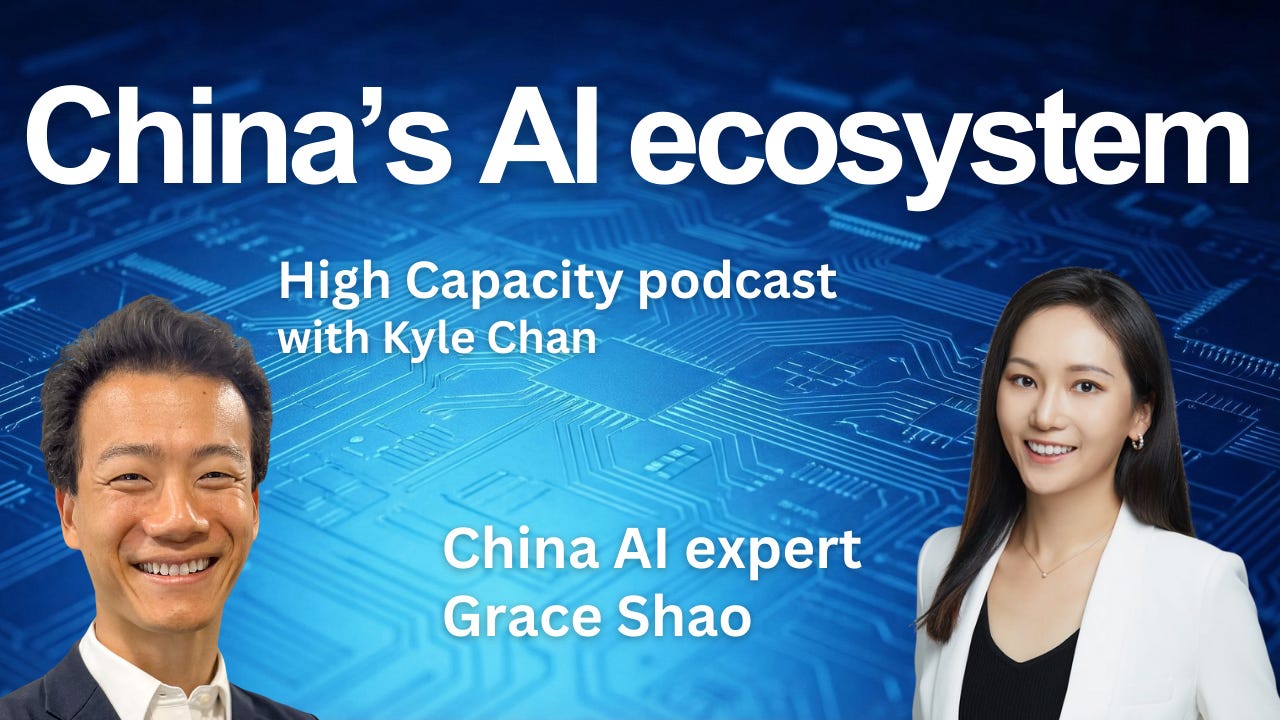
In this episode, I speak with Grace Shao, founder of the AI Proem newsletter and host of the Differentiated Understanding podcast. Grace is an expert on China’s AI and tech industry, with years of experience working with Chinese tech companies like Alibaba, Lenovo, and Kuaishou.
Key takeaways:
Chinese AI companies are moving quickly into AI agents. Beyond mere chatbots, these AI assistants can do useful, real-world tasks such as buying concert tickets or ordering food delivery.
China’s big tech firms are pursuing different AI strategies. Alibaba is integrating agents across its closed ecosystem of services. Tencent is integrating AI into its popular WeChat platform. ByteDance is pushing toward AI-native interfaces, including phones.
China’s AI startups are highly capital-constrained. The recent IPO valuations for Zhipu and MiniMax were only around $6-8 billion. This forces them to pursue different strategies, such as low-cost models or specific industry verticals.
Countries like Singapore are a geopolitical gateway for AI. A number of Chinese AI companies are using Singapore as a launching pad for their global strategies. The case of Manus, recently acquired by Meta, is a striking case study.
One area to watch is AI hardware and devices. China is moving fast on AI wearables, such as smart glasses, and supplying robotics components for the rest of the world.
AI Proem pieces by Grace Shao:
Transcript
Kyle (00:00)
Welcome to the High Capacity Podcast. I’m your host, Kyle Chan, a fellow at Brookings. I’m thrilled to be joined today by my guest, Grace Shao, founder of the fantastic AI Proem newsletter.
Grace is based in Hong Kong and one of the sharpest analysts of China’s AI and tech sector out there, looking not just at the tech itself, but at what’s happening in terms of industry strategy. She spent years covering China’s tech, businesses, and economy as a reporter, and then worked and consulted for some of the largest tech companies like Alibaba, PayPal, Lenovo, and Kuaishou. She also has an awesome podcast of her own called Differentiated Understanding on AI and tech in China, which I highly recommend. Welcome, Grace, and thank you for coming on the show.
Grace Shao (00:47)
Hi Kyle, thank you so much for having me today. And you were just on my show, so people should give it a listen. That was a great episode. I’m very flattered, and again, thank you for having me.
Kyle (00:58)
I’m glad we can return the favor to each other. So just to start off, I was wondering if you could tell our listeners a bit about you, your background, your experience with China’s tech sector, and what inspired you to start AI Proem.
Grace Shao (01:16)
Yeah, I think most people don’t know this about me, but I actually studied finance and first interned at a hedge fund covering China’s TMT sector. And that’s what really brought me to Asia first. I came to Hong Kong in 2014 and really just love the energy here. But while I was working in that role, I realized I really wasn’t good at crunching through numbers at all. And truly I was a storyteller at heart. I think I really always wanted to kind of combine my interest in business and storytelling. So I went to grad school for business journalism, and that kind of gave me the first kind of step into China.
I worked in Beijing for three years and then I moved around to Shanghai. I later on covered China’s tech sector, the APAC tech sector out of Singapore, and now I’m based in Hong Kong. And like you mentioned, over the years—nearly a decade—I’ve gone from analyzing the tech sector as an investor to being a reporter covering the tech sector, following the latest trends, to actually being in the companies, working on their international positioning, their crisis management, working closely with the PR and IR teams, and then later on joining a consultancy and advising them from an external lens.
So today I think I bring—hopefully—a business analytical lens and a storytelling nature to my analysis at AI Proem, and it’s something that’s entertaining and insightful to readers.
On why I really started this: honestly, I think it was just personal. Like I mentioned, I’ve always loved storytelling and business, and I want to tell the business story. But I think in the last few years, there’s just been a lot of geopolitical clout around covering China. And I really wanted to create something that just focused on the businesses themselves, the founders, the entrepreneurs, the really exciting stuff that’s happening on the ground, and remove a lot of the noise in the background. And we all know what’s happening. It is what it is, right? And I want it to bridge that information gap and help people—from, I don’t like to say both sides of the world, but really, in this global environment—understand each other a bit better.
Kyle (03:24)
Yeah, it’s been amazing following your work. And yeah, I love the way that you really go behind the stories and give that concrete narrative there—like, what are they trying to do? What are their goals? Who are the personalities? There’s so much drama in this space. And when you just see it purely as the U.S. versus China in this AI race, it becomes too abstract. There’s a lot of wonderful details along the way. Speaking of which, I wanted to ask you about agentic AI. This is such a big topic these days. I mean, 2025 was supposed to be, in many ways, the year of agents. It was talked about by a lot of the major tech and AI leaders in the U.S. And maybe there was more caution about rolling out agentic capabilities—like on the iPhone or elsewhere—at scale, at least in the U.S. It seems like China is going more heavily into AI agents. It looks like a number of different tech companies are experimenting, trying out different strategies. And I was just wondering if you could maybe talk about what you’re seeing, what’s interesting to you, and who is up to what.
Grace Shao (04:40)
Yeah, for sure. I think I also drank the Kool-Aid. Like I wrote in my recent piece, my husband and I spent last Saturday night just sitting together, tweaking our own agents on Claude Code, and I thought it was so cool what it could do. I think there was a lot of hype around vibe coding over the last two years, but for someone who has no technical background, I really didn’t find a lot of the tools that intuitive until Claude Code. So for sure, I think that was a pivotal moment, and every lab in China is experimenting with something like Claude Code.
But it’s not really just an agent in that format. And I think to your point, a lot of the big tech companies are doing different things and trying to tap into their existing ecosystems.
So on a Claude Code–like product, we can see that MiniMax—one of the four tigers, and it just went public in Hong Kong earlier this year—just launched its own version last week. The agent is called MiniMax Agent, and it is free for use. It really kind of embodies the idea of an AI-native workspace. It has that vision similar to Claude Code. However, I think a lot of people are saying even though the experience might be a bit glitchier than Claude Code, the competitive advantage right now is that MiniMax M2 API pricing is at about 8% of Claude Sonnet 4.5. So there’s that obvious price differentiator for them.
And in terms of the big tech: last year, I think around November or December, Alibaba launched a Qwen app. Previously their consumer app was called Tongyi—in Chinese, Tongyi Qianwen. It just means like a thousand questions are all answered. But we all know the model is called Qwen, and last year they actually rebranded their consumer app to Qwen. So I think it was a really strong signal that, look, the consumer can now access our most frontier model. That was one on branding.
But what do they do? Well, they really tap into their ecosystem. They open up their whole series of apps. And I think for people outside of China, sometimes they don’t realize Alibaba is not just a platform to purchase, say, cheap clothing. It actually has a series of applications. For example, Fliggy—Fliggy.com—is essentially like Ticketmaster plus Booking.com. There’s an app called Gaode, which is their navigation tool like Google Maps plus Uber—you can order ride-hailing. Ele.me, its delivery app, is kind of like DoorDash, and it has so many more. And then obviously Taobao is its flagship application that lets you go into Tmall, which lets you purchase foreign goods into China, or Taobao, which is where you get the cheaper goods, the white-label goods.
So essentially what the agent looks like is a shopping agent. You go to the app Qwen, and automatically it will help you find, search, and complete transactions—because even Alipay, the payment system, is within its own ecosystem. So this is really quite different from what we saw with OpenAI, where it opened up many apps and they’re trying to integrate the shopping feature into OpenAI, because all of those—whether it’s payment, transaction, or the activity itself—has to be done on a third-party platform. But within Alibaba, the data is within its own ecosystem, so the suggestions, the personalization, it is incredible. However, it’s still in early stages, but I just think it shows that China’s agents are looking quite diverse, and they’re not just a workspace agent right now.
Kyle (08:29)
Yeah, no, that’s so interesting. I mean, especially the case of Alibaba—given the breadth and depth of their existing services—once you start to integrate all that together, you kind of build this broader data, user application services ecosystem that is pretty hard to replicate. And I’m thinking in the U.S., Google—Gemini—integrating that with personalized Gemini with Gmail. But those are also digital services, versus Alibaba really reaching out to the real world. You can order food, you can order real products, you can get real things done, buy tickets to concerts—all through this AI app interface.
Grace Shao (09:22)
Yeah, I think for sure. I think Google has a lot of advantage once Gemini is embedded thoroughly into the work productivity tools. And I kind of see it as: if you have to categorize it, Alibaba’s tools are maybe purely consumer applications, whereas a Google agent potentially would be a lot more prosumer-focused. And in this case, Tencent—the rumor is during CNY they will launch a personal assistant in Yuanbao, which is their AI app, consumer app.
And I think in many ways, Google’s feel might look more like Tencent’s feel, because essentially you have the data and the workflow within what you do when you email people, message people, arrange calls, book calendars. It might look a bit more similar on that front. But I think it’s also the issue of: how much does a company allow the walled gardens to come down between business units? And that’s a regulation issue and a compliance issue as well, which we won’t go into details on.
But Alibaba has a culture of a very top-down driven management style, so they were able to really quickly rally everyone—or at least, in some ways, force everyone—to open up their interfaces to Qwen. I think Tencent, some are saying, might be struggling a bit more with that because the company has always operated a bit more in silos from each business unit. They would work together less closely.
Kyle (11:01)
Yeah, that’s so interesting. With Tencent—being the company behind China’s perhaps most powerful app, WeChat—it was always interesting to me that that didn’t give Tencent an insurmountable lead over everyone else, right? You have this huge user base, huge distribution platform, but they in some ways seem like they’re catching up for some of these, especially now looking at AI agents. And yeah, part of it is strategy and part of it is execution and implementation.
And there was something else you had written about, which is this idea about AI apps being platforms, or AI being the platform itself, versus AI being the operating system. We’re used to iOS for our iPhones or Windows when we think about operating systems. But I was wondering if you could say more about what this idea is about AI itself being the operating system and the interface.
Grace Shao (12:14)
Yeah, I think it all ties to what we were just talking about in terms of how AI can now complete tasks. So I’ll use Tencent as an example. It’s a perfect example. And to answer your previous question about why Tencent felt like they were falling behind and how they’re catching up now: Tencent was one of the first to integrate DeepSeek into its WeChat platform. In the beginning, it was a strategy decision, a cultural reason—because they’re always kind of slow to follow, but they’re very good when they execute—and also a technical challenge, because their LLMs have just been one of the weakest amongst BAT, with B being ByteDance here.
This is relevant to your comment about the platform because I think they really saw WeChat as an interface—the entry point into a new iOS essentially, or a new operating system for mini programs, for deploying AI eventually.
Last year—no, the year before—they first integrated DeepSeek into WeChat. It was a pretty bold move because at that point Alibaba and ByteDance were still doubling down on their proprietary models and had all the guards up and didn’t allow multi-model access through their platforms. The thinking back then was: Tencent has distribution through WeChat, and Yuanbao was kind of average in performance. So they weren’t focusing on pushing Yuanbao to the frontier level. Instead, they said, if we can offer DeepSeek—which was the best, most cost-efficient model in China at that point—through our platform, then maybe we can win the AI race by capturing users within the 1.4 billion MAU on the platform, right?
However, I think the idea of using Yuanbao only as an operating system—or an entry point for an operating system—didn’t really work, because if you’re still relying on other people’s models, it’s not the most native to your functionality. And every month when a new model came out—whether it was ByteDance or Alibaba—it would steal the thunder again, and people would move to the best model, because people want the best capability. And it wasn’t just gimmicky; there was significant growth in intelligence every month in these models.
So there was that. And I think there’s definitely been a change in their mentality to still double down on using WeChat as an entry point.
So last year in December, Tencent hired OpenAI’s Yao Shunyu, which is one of their senior researchers, to lead a whole new model in Tencent. And he said at a summit in Beijing that it’s not about humans being replaced by AI; it’s about people who know how to use tools replacing those who don’t. And instead of obsessing over model parameters, it’s more meaningful at this stage in China to teach people how to use Qwen, Kimi, Zhipu, and other tools effectively.
So what we’re seeing right now is they’re doubling down on model expansion and capabilities, but they’re still trying to use WeChat as an interface to capture users and funnel that into the mini-programs, which will then allow them to complete the agentic tasks we just talked about—booking trips, itineraries, booking restaurants, whatever. And similarly, I think ByteDance rolled something like this out.
ByteDance took a different approach. Even though they’re still thinking about iOS, they pushed out the ZTE JV phone last year. They emphasized: look, we’re not going to create our own phones—we’re not going to manufacture our own phones. Instead, we’re offering this essentially new AI-native operating system to the phone. So they’re taking it one level further than what WeChat is doing. WeChat is still: we’re using existing iOS or Android, but you go to WeChat to use WeChat as an AI OS. For ByteDance, we’re creating an AI OS, and you use a phone where the phone itself is AI-natively integrated and can complete tasks within your hardware.
So I think there’s a move towards this idea that in the future, AI will be called on through a new operating system, and potentially it might not be iOS from Apple or Android that we know today.
Kyle (16:24)
Yeah, yeah, that’s really fascinating. I mean, this move with ByteDance, which is the company behind TikTok, with this Doubao phone really made a lot of waves. And I think the phone was sold out really fast. It offers agentic capabilities that a lot of people expected Apple to roll out at some point. Even Google Android phones don’t offer these kinds of capabilities, right?
Kyle (17:16)
You still need to manually click your app, go through, scroll down, input whatever you want to input. And here—I haven’t tried one myself—but watching the videos, it’s kind of magical to see your phone run on autopilot and accomplish tasks for you, seemingly across apps as well, as if a human were right in front of you operating your smartphone.
More broadly on ByteDance: what do you see as their approach with Doubao, which I believe is the most popular AI app in China, which is maybe surprising to outside observers who might be more familiar with DeepSeek, for example. Why is Doubao so popular, and what is ByteDance’s broader strategy with AI?
Grace Shao (18:09)
Yeah, I think definitely DeepSeek has stolen the headlines because of its model capabilities, but it’s not really focused on the consumer market. I think Liang Wenfeng has openly shown he’s not that interested in capturing the consumer market or trying to profit from that. He is an AGI-pilled guy inside out—he’s really trying to chase frontier research.
But Doubao—people don’t realize, first of all, they spent a lot of money on marketing in the beginning. They went into the consumer market earlier than Qwen. Alibaba only really pushed into the consumer market quite recently. Tencent integrated DeepSeek into their platform quite early, and their models were lagging in the beginning, so that put Doubao in a very good position.
For a lot of people, they might not realize Doubao still came quite late, even though it went consumer early. The Doubao model lab came really late—it was officially launched in August 2023. This is already right after OpenAI redefined expectations globally. It’s already after Baidu, and even Alibaba, had made two or three iterations of their models—people already knew about it. But it was very fast to go 2C immediately.
And to your point, it’s probably the most popular consumer app right now in terms of MAU. I think the latest numbers say it reached 300 million MAU and about 100 million DAU, so they’re really leading. In comparison, I think Alibaba’s Qwen app hits about 100 million MAU at this point. ByteDance’s AI assistant also reaches a scale that is really threatening legacy traffic modes.
There’s also cultural context here to show how successful they are. It was just announced this week that ByteDance Doubao secured an exclusive CCTV Chinese New Year Gala AI partnership. And that’s a clear signal that Beijing is supportive of them, because the CCTV Chinese New Year Gala is probably the most-watched TV show for Chinese people globally, including the diaspora. I think it reaches about 700 to 800 million people globally, and it’s completely vetted by the government.
Kyle (20:15)
Yeah.
Grace Shao (20:36)
They’ve been quite successful in courting everyone. However, because they’re a private company, they’ve remained a lot less vocal about their strategy—at least they don’t have to publicly disclose what they’re doing every quarter, unlike Alibaba and Tencent.
But their entertainment distribution is second to none. In the West, we know TikTok. In China, we have Douyin, and users can go through Douyin and access Doubao directly for chat, creative writing, and AI-generated content. At the end of the day, ByteDance’s mindshare is extremely high in China. So I think although people in the West don’t know so much about Doubao, they know ByteDance. And sooner or later, I believe ByteDance will win in this consumer race in terms of an AI-empowered creative tool or entertainment tool. In many ways I see it similar to Meta in terms of distribution, reach, and potential. It’s just a matter of when they push out all the AI functions through their existing platforms, and then people will get hooked.
Kyle (22:05)
Yeah, no, that’s so interesting. In some ways it makes sense that each of these companies is trying to play to their strengths—leveraging not just competing to have the best model, but integrating into their ecosystems, whether it’s social media–based or e-commerce. Did you want to add something?
Grace Shao (22:13)
Mm-hmm. Exactly. No, I was just saying: exactly to your point, when you look at Chinese big tech companies—ByteDance, Tencent, Alibaba—they’re all trying to tap into the ecosystem. That’s the easiest way into the consumer market. And ByteDance, because of their existing products such as Douyin, TikTok, Jinri Toutiao—their strength is multimodality. Their strength is not helping you send a message—that might be Tencent’s strength eventually. So their agents will be focused on exactly what they’re good at. And I think that’s where the real breakthrough we’ll see this year.
Kyle (23:11)
Yeah, super interesting. Related to this, I was wondering if you could talk a bit about some of the other players beyond BAT—beyond Tencent, Alibaba, and ByteDance. Some startups like Zhipu, MiniMax, Moonshot—some are listing on public markets and raising money. It’s interesting to see how they each reveal slightly different strategies. Any thoughts on seeing this unfold? It’s been quite an enthusiastic time for the Chinese stock market for these new IPOs.
Grace Shao (23:56)
Yeah. So the four tigers—let’s start with that. The four LLM tigers are MiniMax, Moonshot, Zhipu, and Baichuan. Essentially these four labs all started anywhere between 2022 to 2023. They’ve been in this space for a while, so they weren’t just followers after the ChatGPT moment—they’ve been around as well.
In the beginning, they all focused on creating the best frontier LLM. However, now quite a few of them are pivoting or focusing on verticals, and I think that’s a very pragmatic business decision. For example, MiniMax and Zhipu just went public this year—early this year—on the Hong Kong Stock Exchange, both at around six to eight billion dollars, I believe. These are crazy small numbers compared to what we’re seeing in the U.S. in terms of AI lab valuations right now. But there’s a lot of capital constraint for these companies. We all know training and inference costs a lot, and it’s not a game for the poor or scrappy, unfortunately. That’s why we’re seeing big tech leading in model training and deployment.
Kyle (25:15)
Yeah.
Grace Shao (25:23)
And then DeepSeek obviously has its own funding from its hedge fund business. Because of that, you can see MiniMax and Zhipu trying to sell the global story. They’re both saying they’ll have frontier models, and they’ll be cheaper APIs compared to global peers—hint, hint, American labs. And the joke is someone at Zhipu came on my podcast and said: if Anthropic sells for $200, we sell for 20 bucks. That’s the game they’re playing.
They’re thinking of deploying to the Global South. That’s their strategy. They’re thinking of providing model-as-a-service to SOEs across Southeast Asia, and to clients who are more cost-constrained—mid-size, small-size firms. That’s the niche they’re going after.
And in terms of Moonshot: it’s still a private company, but it’s currently the most well-known lab out of the four because of its Kimi models. It’s been pushing frontier research, and recently fundraised within China. Its founder, Yang Zilin, is very focused on AGI. And he’s a charismatic and interesting person, from reading about him and talking to people in the industry. He named his company Moonshot because he said what they’re trying to do is like landing a rocket on the moon. This is what they’re chasing. They’re not going to get distracted by going to consumers or selling to enterprise—they just want the best research.
This is important to note because I think in 2024, Kimi—its consumer app—was at one point one of the most popular in China, and it was competing for first consumer mindshare with Doubao. And I think in the end, Kimi decided we’re not going to put our resources here—Doubao, you can take it; you have more money for marketing and consumer branding—but we’re going to focus our energy back on research.
Baichuan is the one that’s kind of shied away from everything now and is focused on vertical AI, serving the healthcare industry and working with healthcare institutions to find solutions in that sector.
So there are quite a few labs in China, obviously, but the really relevant ones in the global race are maybe the four we mentioned, and then the big tech.
Kyle (28:14)
Yeah, that’s great. It’s so interesting to see the diversity of strategies—how they’re trying to come up with AGI and push benchmarks to the limit, versus consumer-facing applications.
To wrap up this section, I was wondering if you could speak about your view looking across the broader Chinese AI landscape. How do you assess the approaches these companies are taking, and how would you compare that to what we see in the U.S.? And how has that changed over time? You’ve written fantastic pieces about whether they’re running different races or converging to some extent. So I was wondering if you could share some insights.
Grace Shao (29:17)
Yeah, I think my observation was that—first on the startups—they kind of have to go vertical and niche because, to our earlier point about distribution ecosystems, they simply cannot win users from scratch compared to Alibaba, ByteDance, and Tencent’s existing reach. And no one in China has that number-one seat that ChatGPT has really taken up in the U.S., in that sense.
In terms of strategy and how it’s evolved: quite a few of these startups talked about how prior to the ChatGPT moment—November 2022—no one in China took their labs or companies that seriously. It was extremely hard to get funding. And I think that’s because the VC ecosystem here is pragmatic—they want to see a potential product, something feasible and sustainable before they give money.
So when ChatGPT came out, all of a sudden it was easier to fundraise. And after that moment, big tech realized this wasn’t something to be taken lightly—it would be the next playbook or tool or evolution within the internet space. So it pushed both labs and big tech to chase frontier research.
Then when DeepSeek shocked the world with V3 and R1 over Christmas and CNY, it showed there’s a clearly cost-effective way to push forward research. There was sheer excitement and a frenzy—even companies talking about integrating AI into robotic vacuums, AI tutors—it got very crazy for a little bit. But then it tempered down.
And the idea of quick diffusion of AI into the real economy also met challenges. When your technology isn’t good enough, you can’t keep users. The moat isn’t there. Something better will come out, disrupt behavior, and users will go to the new product.
Kyle (31:28)
Right.
Grace Shao (31:29)
So over time, that excitement tempered, and labs and frontier research labs pivoted back and said: okay, we need to develop two things in parallel. One is deployment and diffusion, which Chinese companies were really good at in the beginning. The second is frontier models and synchronization.
And again, if you look at Yao Shunyu joining Tencent, you can see that mentality switch. In the beginning it was: let’s bring in whatever model we can that’s best into our ecosystem, as long as users can access it. Now they’re thinking: how do we create the best model for our users, AI-native to our ecosystem and functionalities, and find that functional adjacency?
On the other hand, in the U.S., in 2024 and early 2025, there was a lot of obsession with chasing AGI, and that was it. There wasn’t much conversation about how AI integrates into the real economy. There was conversation about AI disrupting the labor force, but less about how AI creates new jobs or new value. And that’s shifted.
I think there’s now much more focus and balance among regulators, builders, policymakers, and investors on how to balance technological advancement and diffusion in the most cost-effective way. It might sound less exciting, but in many ways it’s the most sustainable way forward.
Kyle (33:35)
Yeah. It’s fascinating to see different ways of talking about the same technology. And regular people’s attitudes toward AI are interesting too—you have the Silicon Valley bubble, and maybe a tech bubble in China, versus your regular Douyin user or your regular Gmail/Google Search user who sees ChatGPT as a kind of super search, and maybe a personal therapist on the side. To me it’s fascinating to see how it’s being used, and the strategies around that.
I was wondering now if we could shift to Meta and Manus and this really high-profile deal. There are so many things you can read into it. But what happened there? What was the announcement? Why does it matter so much? And what do you make of it all?
Grace Shao (34:58)
Yeah, I think to start with some context: Manus is an agentic AI company—a tool—and it was founded in Beijing. It had a few iterations of branding and product, but we’ll focus on what happened with Meta.
In 2024, it moved its headquarters from Beijing to Singapore. And from Singapore, that’s when they first received their major U.S. capital injection from Benchmark. That was a big deal because it was Benchmark’s first China AI deal, and also one of the highest-profile Chinese AI companies receiving U.S. capital in this sensitive period with the geopolitical backdrop.
Because it received U.S. capital, it had to restructure. It trimmed its Shanghai research team, its Beijing people, and relocated a majority of its co-founders and leaders to Singapore.
And then just recently—a couple weeks ago, maybe two months ago—Meta announced that it bought out Manus for roughly $2 billion.
It was a big deal because a lot of people thought there weren’t exits for Chinese companies going abroad because of AI sensitivity. However, this was a first high-profile one.
I think it’s also a big deal because over the years we’ve seen Singapore benefit in this geopolitical era, if you want to put it that way. In the late 2010s, we saw expats and Western companies move their Hong Kong APAC headquarters to Singapore to soften China exposure. Then there was an influx of Chinese entrepreneurs setting up family offices or offshore accounts in Singapore during the early 2020s regulatory probe in China.
So Singapore opened its arms to money, talent, and vibrancy. Language-wise and proximity-wise, it’s a natural step. Singapore has a Chinese-majority population and they speak Mandarin, while the official language is still English. So whether you’re doing business with the West or with Chinese counterparts, it’s an easy place for companies to stop.
We’ve seen companies do what’s called China-shedding: a Chinese-born company moves to Singapore and softens or severs ties to China, saying they’re now Singaporean, to remove themselves from geopolitical sensitivities or restrictions.
People are watching if this will continue. Soon after the deal was announced, Chinese regulators said they would investigate. People are analyzing it and saying it’s fair because the R&D was done in mainland. If you take that IP outside China, there are restrictions and it may need to be investigated.
So people are focusing on what it means for entrepreneurs who want to build in China but potentially exit outside China—or whether future Chinese AI companies must find exits in China, like what we saw with MiniMax and Zhipu going to the Hong Kong Stock Exchange (or even Shanghai). In many ways, $2 billion isn’t huge, but it’s very symbolic.
Kyle (39:03)
Right. Yeah.
Grace Shao (39:28)
So I think a lot of people are watching to see what comes out of this, especially whether the investigation goes through and whether the deal can successfully go through with Meta.
Kyle (39:28)
Mm. Yeah, yeah. It’s been at the intersection of so many geopolitical and technology issues. And it’s amazing to me on the Meta side that Meta feels like they’re trying to catch up. There’s a lot of excitement around the latest Gemini models or now Claude Code. And to get back to the frontier and be back in the race, it was interesting they looked to a company with origins back in China, and this viral agentic startup that had something Meta didn’t have on its own.
So this acquisition was a story of a technology born in China that moved to Singapore, that maybe is going to the U.S.—a “to be continued” story. And they’re not the only ones who’ve done this Singapore strategy, right? What are some other companies that have tried this move to Singapore or used Singapore as a hub?
Grace Shao (40:56)
Yeah. I think—I’ll say this carefully—lots of AI companies are trying to do so, but they don’t want to be talked about. They don’t want to be flagged.
But exactly to what you’re saying: it shows that even in this globalized world, there’s no such thing as really decoupling. If the technology is good and talent is mobile, how could you stop transfer of information or transfer of ideas? And Meta, if anything, is known to have a majority of engineers who are Chinese ethnic, so there might even be personal relationships between engineers and founders.
So it’s hard to say we’re just going to decouple. I think it’s impossible and not conducive to anyone.
And companies were doing this before. We talked about the early 2020s China-shedding move, and the most famous case study was Sequoia. Sequoia had a huge operation in China and used to just be Sequoia. They spun off their China business and renamed it Hongshan, which is a literal translation of “Sequoia” into Chinese. They separated the businesses, and the Sequoia team either dissipated, were let go, or some moved to Singapore.
ByteDance is also notorious for this. When TikTok was being investigated in the U.S., they moved key figures within the TikTok org chart to Singapore, hired a Singaporean CEO, built a massive ByteDance headquarters there, and repositioned TikTok as a Singaporean company.
Singapore has long been crucial for big tech companies and investment funds globally. Meta and Google have APAC headquarters in Singapore. ByteDance, Alibaba’s Lazada, and Tencent have APAC headquarters there too. It’s a very talent-concentrated place. Even though the market is small, it’s been a gateway to fragmented Southeast Asian markets. And in more recent years, it’s been a gateway for going into China—or going out of China to go global, what they call going to the West.
Kyle (43:42)
Yeah, yeah. It’s ironic that Singapore’s role as a gateway between China and the rest of the world—and Asia and the rest of the world—has been around for a long time. And now with something so new like AI, cutting-edge technology, Singapore is again playing that role.
Some of these long-established factors—its position, geopolitical positioning, institutions, access to capital—keep it playing that role. A lot of other countries look at Singapore and wish they could replicate that navigating, especially now with growing tensions with the U.S. and China.
So do you think this will be a viable pathway going forward? Do you think we’ll see more companies doing this Singapore strategy—or moving elsewhere? Or is it too hard to tell?
Grace Shao (45:14)
I would say I’m not a policy expert, so I don’t really know how to predict what governments would do. At the end of the day, we all live under restrictions that governments establish for business.
But Singapore is interesting. I recently went to Singapore and thought about it. It’s a country of only 60 years of establishment. People think of it as a prosperous city-state, but it’s always been pragmatic for survival and prosperity.
In many ways it’s very Chinese: predominantly Chinese ethnic, early prime ministers were Chinese, they believed in education and talent schemes, and working closely with Chinese relatives from afar. There were many Chinese migrant workers in the early days. However, it’s also very Western: it embraced free trade, democratic values, and things that in the West we think of as Western characteristics.
So it’s always played that role and courted both sides—if you must say that they’re against each other. They’re not against each other, but in terms of differences, Singapore sat in the middle. And today’s young Singaporeans mostly speak English and their ethnic language proficiently. They have a pragmatic sense that for a country so small—by population or geography—they always had to play the game. People like to think they’re Switzerland.
But Kevin Xu wrote a great article saying Singapore is not Switzerland. Singapore is not neutral. Singapore is pragmatic. They will choose what is beneficial to their own people.
And we saw recently at Davos—getting a bit further away—but what Carney said was that these middle countries might need to think about what is good for their own citizens. That might mean choosing certain countries’ cheaper or more efficient goods, but also leaning into certain countries’ ideals, values, and political systems. These are decisions of government leaders and policymakers.
I don’t cover that space, but I think Carney’s speech shed light on the idea that Singapore has benefited from almost all the happenings, and they made sure what they do is best for their people.
Kyle (48:25)
Right. Singapore is a special case of a broader phenomenon: how do all the other countries in the world that are not China or the United States navigate this period? To the extent they take a pragmatic approach, they’re thinking about their own consumers, citizens, and workers. I don’t know if there’s such an ideological bend to how they operate. Increasingly, it seems like pragmatism is the new ideology, as it were.
Grace Shao (49:06)
Yeah. Sorry—just one comment on Singapore. People don’t realize they’re not mindless, like “give me money, I’ll take it.” They’re extremely mindful in planning, and I think it’s admirable.
For example, we talked about bringing talent from China and from the U.S. and Europe. But there are schemes where—at least when I was at CNBC—there was a 6-to-1 ratio: for every foreigner you hire, you need to guarantee a job for a local. There are housing schemes where young newlyweds get subsidies to purchase a house. There are huge tariffs on imported cars to ensure streets aren’t too congested and roads aren’t too polluted. There are harsh policies, but they ultimately benefit people—the citizens, the average lao baixing who live there.
Kyle (50:06)
Yeah, yeah. That Singapore model has been enduring for quite a while now.
Now looking forward: what trends are you following closely now in AI in China, China’s internet ecosystem? What are you paying attention to for 2026 and beyond this year? What do you think everyone else should be paying more attention to?
Grace Shao (50:39)
Yeah, I think we touched on agents at the very beginning. I think 2026 is really when we’ll see agents come to life. In 2025, a lot of people talked about agents. I tried a few agentic tools, but as a layman I didn’t feel the ability to take away mental load or workload. But with what we’re seeing now—especially with Claude Code’s newly launched product—that has shifted how I see agents.
I think we’re going to see how different companies build out agentic tools within their ecosystems—Google with Gemini, Tencent with their Yuanbao app, Alibaba continuing to push Qwen integration within their ecosystem. That’s what I would focus on.
Another thing is interface. We talked about the potential of an AI OS disrupting the old OS system. Honestly, if Apple pushes something out, they’d still probably win because we’re all slaves to our iPhones. I cannot live without my iPhone anyway.
Kyle (51:47)
Right. Yeah, same.
Grace Shao (51:51)
Yeah, but if they can sort out the AI side, I think we’ll still stick with it. But eventually we’ll see a change in how we interact with AI—whether it’s a new OS system or something as simple as interacting a lot more through voice.
I was inspired recently in Singapore at an event where the Grab CTO—sorry, CPO, chief product officer—said people think AI and wearables are gimmicky because for people like you and I, we’re knowledge workers and sit at a desk. We don’t really need a wearable—our hands are free. But what he said was: with Meta glasses, especially if they can be cheaper, they can enable laborers—for example, Grab delivery people—to navigate roads better if they’re wearing glasses. If it frees up their hands, it could be safer and more intuitive, because their work is oriented through their eyes—roads, storefronts, apartment complexes, addresses. So potentially we can think about how we interact with AI leaving our phones and devices as we know them today.
Kyle (53:24)
Yeah, that’s so interesting because I often think: who benefits from all this? Who gains more, and who loses out? Some intuitions get flipped—for example, worries that AI might displace white-collar workers faster than blue-collar workers.
But with wearables, who benefits might not just be people like us, the laptop class. It could be very beneficial for people out in the world—food delivery, construction workers, people working on physical sites who need to engage with the physical world in a totally different way.
Grace Shao (54:18)
Exactly.
Kyle (54:21)
And wearables also seem to play to China’s strengths—consumer electronics, hardware supply chains. And I think Meta’s glasses and some other U.S. wearables are made in China, or a lot of the components come from China. So that’s another interesting aspect.
If it’s purely the models, maybe Google with TPUs is hard to catch up to. But if it’s deploying in the real world, it’s more varied in terms of who stands to gain.
Well, this has been really fantastic, Grace. You are such an amazing person on this topic and related areas. I’m so glad we got a chance to finally have this chat. Any last thoughts you want to add before we wrap up?
Grace Shao (55:39)
Yeah, I think just—when you were talking about hardware—I recently met a company that’s essentially an accelerator. They help European companies and even South Asian companies find hardware supply chains in China, and they’re creating white-labeled robots. It’s crazy.
Back then, we’d think: okay, this shirt or these sneakers are made in China, then you put a Nike logo on or a Zara logo on, and it becomes American or Spanish. But now it’s funny—there’s a huge business in this unsexy area people aren’t looking at, which is the supply chain of robots. They’re producing arms and legs and engines and machinery, shipping it out to a European country, and then a company there assembles it, puts a logo on, redesigns it slightly aesthetically, and it becomes essentially a German or French robot. It’s very interesting—there’s a lot of that happening as well.
And I just want to say: we spent a lot of time today talking about the fusion of AI into the real economy. As someone wrapped up in this, I’m very excited about what it can do. But I hope AI safety people can come up with more standardized international standards on how to regulate this—especially with wearables. I’m very, very scared about what that means for the future of our children—their safety, their privacy, and how that will interact with them down the line. If anything, I hope internationally people can collaborate more on standards and regulations, even if they don’t see eye to eye on politics and other things. This will be very important for the future of humanity, I believe. But yes—thank you so much for having me on your show today.
Kyle (57:24)
Yeah, yeah. Yeah, I completely agree. That’s a really great point. Thank you so much, Grace. This was such an awesome conversation. If people want to learn more about you and your work, where should they go?
Grace Shao (58:03)
Well, please check out AI Proem on Substack. That’s AI, P-R-O-E-M. And people ask what that means—it’s a very nerdy way of saying “preface.” Or check out the podcast Kyle was just on as a guest, called Differentiated Understanding, on YouTube, Spotify, or Apple. If you ever want to reach out to me, feel free to ping me on any of these platforms.
Kyle (58:13)
Fantastic. All right—thank you again, Grace, for coming on the show. If you like this episode, please rate and subscribe to the show on YouTube, Spotify, or Apple Podcasts. You can find episode transcripts and more information on the High Capacity Newsletter at high-capacity.com. And I’ll include links to AI Proem and some select pieces that Grace has published recently. I’m your host, Kyle Chan. Thanks for joining, and see you next time.