

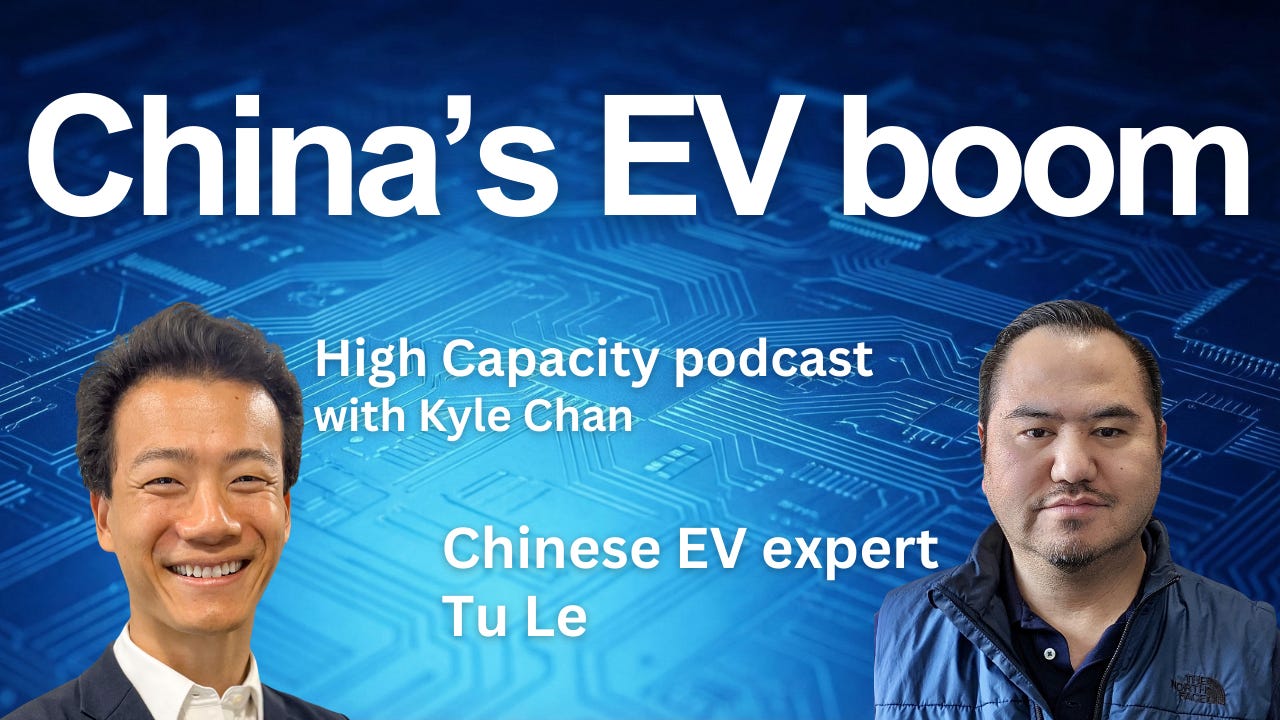
Podcast: Chinese EVs are transforming the auto industry
An hour-long conversation with Chinese EV expert Tu Le

Watch or listen to the High Capacity podcast on:
In this episode, I speak with Tu Le, founder and Managing Director of Sino Auto Insights. He’s one of the best-known experts on China’s EV industry with years of experience working in Detroit, Silicon Valley, and China.
Key takeaways:
Chinese EV makers are transforming auto manufacturing. They’re taking a page from consumer electronics and compressing timelines for launching new models.
Geely is planning to enter the US market. Despite US tariff barriers and security restrictions, Chinese EV makers still want to reach the US auto market, likely through investments in the US.
Western automakers are using Chinese EV tech. Through partnerships and investment deals, some legacy automakers are leveraging Chinese EV platforms and battery technology.
Chinese EVs are not just cheap; they’re packed with features. Megawatt charging, in-car fridges and theaters, drone selfies, karaoke systems.
China is pursuing intelligent driving on multiple fronts. Robotaxi services like WeRide and Pony.ai are launching in cities around the world. Meanwhile, smart driving systems for Chinese EVs are moving up the autonomy scale.
Links:
Transcript
Kyle (00:00)
Welcome to the High Capacity Podcast. I’m your host, Kyle Chan, a fellow at Brookings. I’m thrilled to be joined today by my guest, Tu Le, one of the absolute best experts on China’s EV and automotive industry. He spent years working in Detroit and in Silicon Valley, including at Apple on their supply chains. Then he later moved to China, where he spent over a decade working with Ford and a number of Chinese startups. Now he’s the founder and managing director of Sino Auto Insights, a global tech consultancy focused on transportation and mobility. He’s also the co-host of the podcast China EVs and More with Lei Xing and the author of the SAI Weekly newsletter—both of which I highly recommend. Tu, thank you so much for coming on the show.
Tu Le (00:54)
Kyle, thanks for having me.
Kyle (00:56)
So I thought we would start with the technology. There’s this view out there that Chinese EVs are getting popular because they’re cheap—that affordability is the main thing that gives them an edge. But we both know they’re actually packed full of technology and cool features. A lot of stuff you won’t find elsewhere, like megawatt charging, fridges, or even theater systems built into the cars themselves. I was wondering if you could call out a few interesting features—maybe even things that you saw recently at CES—stuff that would help our American audience realize what they’re missing.
Tu Le (01:42)
Well, you stole my thunder a little bit, because I was going to mention a few of those things already. Companies like BYD have drones on top of their vehicles to do selfies while you’re driving. Also karaoke—very unique to China. An anecdote: a couple of years ago, Tesla sold a microphone for their vehicles in China—nowhere else—and it sold out within, I think, a week.
But on the unique technology: battery swapping is a major, major thing, and it’s successful in China. People kind of poo-poo it around the rest of the world, but there are a couple of reasons it works in China. Number one is the density of most of the cities and the size of the vehicle market. It might not make sense in parts of Europe where there are 200,000, 300,000, 400,000 people, but in a city like Shanghai, where there are 25 million people, or Beijing, 22–23 million, if there are enough NIOs, then it makes sense to have battery swapping.
And then the second thing you mentioned: ultra-fast charging. Last year—in April, right after the auto show—BYD had a little gathering and they showed off mega charging, the ultra-fast mega charging. There was a marketing term they used in Chinese, but it effectively translates to “as fast as gas.”
And what’s important here is that—well, let’s also talk about intelligent driving. In the United States, we think of FSD. Some people might think of Super Cruise and BlueCruise, but what other options are out there for intelligent driving? No one else is really offering it from a brand-name standpoint. But if we look at the China market, XPeng has XNGP, NIO has NOP.
Kyle (03:21)
Yeah, yeah.
Tu Le (03:35)
Lei and I—two years ago—drove an XPeng G9 from Beijing to Shenzhen. Ninety percent of the miles were using their L2-plus system. And then last year we took a NIO ET5 and we only battery swapped, and we used their L2-plus system for about 90% of those miles. Then BYD last year drops a bomb: their system is actually called God’s Eye, and they’re offering it as standard for 20 of their 22 models. So it’s not only that these vehicles have these great technologies—people talk about democratizing technology—but that’s what BYD just did. And that might have pulled intelligent driving forward for the rest of the world by 10 years, because BYD is in over a hundred countries. So we’re going to look back at this time.
Tu Le (05:02)
Even though there’s a huge price war in China and the Chinese government is talking about involution, I think in the automotive space globally, we’re going to look back at this time as some of the most innovative in the history of transportation.
Kyle (05:16)
It’s a really, really exciting time to see the whole industry transform. And you just came back from CES, and there were an unusual number of Chinese EVs represented there, showing off their latest wares—new capabilities, new features. I was wondering if you wanted to highlight any of those—anything you learned while you were out there.
Tu Le (05:40)
So there were two major OEMs featured at CES: Geely and Great Wall Motors. Now there’s another company called Dreame, which is like the Dyson of China. They also showed off—yes, like high-end intelligent vacuums. They had one of the biggest booths at CES; look up Dreame.
Kyle (05:58)
Vacuum makers.
Tu Le (06:10)
They showed off their electric vehicle. Yes—and it’s supposed to be an ultra-premium competitor to a Bugatti-type vehicle, but at a much cheaper price point. It just points to the ambitiousness of the Chinese. And the two main languages outside of English that I heard walking around all the convention halls were Korean and Mandarin.
And we talk about the politics and the relationship challenges between the United States and China, but that’s not stopping businesses from wanting to be players in the United States—or at least exposing U.S. and Western media to what’s out there from China. And I think that’s an important point to make, just because as it seems like things are getting more restrictive, you’re not seeing that at the ground level here in the United States.
And one thing that’s really important that you and I talked about offline: Ash Sutcliffe, who’s the head of international PR for Geely Holdings, had a quick chat with John McElroy—an Autoline journalist, an automotive journalist legend here in Michigan. They sat in a Lynk & Co vehicle, and Ash said Geely will be in the U.S. market within the next 36 months. So the countdown clock for the legacy automakers is now ticking.
Kyle (07:52)
That is a stunning announcement. We think about all the barriers that have been put up—whether it’s 100% tariffs from the U.S. on Chinese EVs, or the connected vehicle rules worried about data flowing through EVs. Despite all of that, it’s fascinating to see a company like Geely say, “We’re going to do it—we’re going to find a way.” And I’m curious to see how U.S. automakers react to that kind of throwing down the gauntlet.
Tu Le (08:33)
Well, if you think about Geely, they’re probably the most international, if you look at their portfolio of brands. They have Volvo, they have Polestar. They have a factory in South Carolina that’s currently underutilized. So this makes sense financially, because if I’m a Chinese OEM with uncertainty about entering the U.S. market—because the current administration is kind of back and forth a little bit on its policies—it would make sense that Geely has first-mover advantage because they already have a facility here. They don’t need to invest billions of dollars in building a greenfield factory or a brownfield or something like that.
All that being said: as a Michigander and someone who grew up working at the traditional automotive companies, I’m fearful for the U.S. automakers. But as a consumer who doesn’t like the direction of MSRPs in the United States tipping over to $50,000, we need more competition at the low end. And I think the Chinese will bring that.
Kyle (09:50)
Yeah. Speaking of some of these Chinese companies, I was wondering if you could take a step back and help us navigate the landscape of Chinese EV companies—all these different brands. People might have heard about some of them: BYD, Geely, some of the newer ones like XPeng and NIO. There’s this proliferation of brands. Now we even have Dreame coming on with their own EV, Xiaomi—which I remember when Xiaomi was an air purifier and smartphone maker, and now they make really, really cool EVs. So I was just wondering if you could give us the buckets of Chinese EV companies and automakers we should be following.
Tu Le (10:39)
Yeah, no problem. So in China there are state-owned enterprises, or SOEs. The requirement the Chinese government made 40 or 45 years ago was that if foreign automakers wanted to come to China, they needed to create a joint venture with some of these state-owned enterprises. Some of the strongest SOEs are SAIC (Shanghai Auto), GAC (Guangzhou Auto), and FAW (First Auto Works). They’re strong because they’re all located in different parts of China. Notable joint ventures are SAIC with Volkswagen, SAIC with General Motors, FAW with Volkswagen. And when we look at those guys, they do sell in the millions of units.
So historically there’s these state-owned enterprises, and technically there are only three independent automakers in China—loosely—because in their home markets, where they’re headquartered, they get a lot of support. BYD is in Shenzhen and gets a lot of support from the city. For example, if you go to Shenzhen right now, I believe every single bus is electric and most—if not all—have a BYD badge. The taxis in Shenzhen—we’re talking tens of thousands of them—are all BYD, all electric.
So BYD, Great Wall Motors, and Geely are technically independent. And if we think about those three, they’re also in the millions of units of sales. BYD is such a compelling story because less than five or six years ago they were at 700,000 units globally. Last year they hit 4.6 million units. What’s really impressive is not only did they have that demand, but they could build to that demand. They didn’t leave anything on the bone. They made sure they were able to accommodate it because they’re vertically integrated.
Tu Le (13:05)
They fab their own silicon, they make their own batteries. So they’re a unique animal. You’re seeing Tesla, Rivian—Ford, I was at a Ford press event yesterday—they said they’re bringing mostly everything in-house. So this is a trend toward control. They see that BYD is able to control a lot more because they do these things in-house. But just like Apple is a unique company, BYD has a formula that works.
With all that being said: Great Wall Motors, Geely, and BYD are in the millions. I would also put Chery into that mix because they have several million units of sales.
And then we get into the startups: the NIOs, the XPengs, the Li Autos. They’re in the hundreds of thousands of units of sales. They’re primarily electric or EREVs—extended-range electric vehicles. In the United States, they might call them REEVs, but in China they call them EREVs. And Li Auto—up until last year or two years ago—were only selling EREVs. Now they also sell EVs, the most famous or infamous probably being the Li Auto Mega, that wedge-looking MPV.
One of the tech companies you mentioned earlier, Xiaomi, is around 14 or 15 years old. I remember because in 2010 I was living in Beijing when they launched. Their automotive division is only a little over four years old. They’ve thrown a monkey wrench into the market because they have two products and they’ve hit over 400,000 units of sales in four years. To give you a quick comparison, XPeng and NIO, which are closer to 10 or 11 years old, are hitting the 400,000-unit mark with many more products in the market.
I’m not trying to oversimplify it, but those are the buckets I’d use. There are still brands launching—like you mentioned, Dreame with new vehicles—and that’s what makes the China market so ultra-competitive.
One other point: most cars—let’s say over 85%—that are purchased are under 300,000 to 350,000 RMB, which is less than $40,000–$45,000. These companies mostly live in the mass market. That’s what differentiates the China market. If we go to the premium side, the average buyer of a Mercedes or a Cadillac is 20 to 25 years younger than in Europe or the United States. Because of that age difference, they embrace technology and digital much more.
Kyle (16:31)
Yeah, this is fascinating. There’s such a huge range of models coming online—from ultra-luxury competitors to Bugatti or Lamborghini all the way down to the mass market. You have basically minivans for families—you have the full range. It’s whatever you can think of.
I want to come back to your comment about Xiaomi being so fast at going from zero cars ever made to suddenly becoming a major player with some of the most sought-after models like the SU7 and now the YU7. I wanted to read back a quote you said on your China EVs and More podcast: you said Chinese EV brands are acting more and more like consumer electronics. If they’re not seeing the sales they want with a model, they can go back and refresh it in 12 to 14 months. You said the automotive space is starting to mimic the technology space. Can you elaborate? What did you mean by cars becoming like consumer electronics?
Tu Le (18:03)
Let me qualify that first, because what I don’t like is the comparison a lot of media outlets make—calling it a “mobile phone on wheels”—because it’s not. Different use cases. Your mobile phone can’t run you over and kill you. That’s the biggest difference, and oversimplifying it misses the point.
Now, the complexity of the technology, the digital, the software—yes, we’re getting to that level. They’re changing the game. Traditionally in automotive, you would design and engineer a component—like a door handle—then build three, four, five prototypes, and test it that way. The Chinese are doing simulations. Toyota—best in class before the Chinese came in and changed the game—had product development cycles like 36 or 38 months, or something like 40 months. So clean sheet to Job One in about four years. The Chinese can do it in 12—let’s say 14 to 16—months.
There are a couple of reasons. The platform is pretty basic and universal, so they can shorten and extend it without creating a brand-new platform. And then the “top hat”—a lot of that is design. And the most important part of the top hat—the seats, everything—is going to be software and integration.
And I’m going to get on my soapbox, Kyle: I hate the term “software-defined vehicle.” As an Apple alum, how come we don’t say “software-defined phone” or “software-defined computer”? Because that’s not what it does. It enables great design. It’s the integration of hardware and software that creates the experience.
I’ll give you a quick example. We’re used to our Android phones and iPhones where the latency is effectively zero. If I touch the screen, something happens. A big challenge automakers had early days when they started becoming “software-defined” was as simple as touchscreen latency. You and I are used to immediate responsiveness, but when we go to our Volkswagen it might take half a second. By then, you’ve pressed it two more times—so when it catches up, you’re three layers deep instead of the one layer you wanted.
Those are the simple things. As an ex–Silicon Valley guy who worked at arguably the coolest hardware-software integration company in the world, those are the things the Chinese companies really lean into. One important note: Li Xiang (Li Auto), Li Bin (NIO), and He Xiaopeng (XPeng) all started as technology guys. They made their wealth from tech companies. Their mindset isn’t first “factory capacity” or “components and supply chains.” They looked at it through a technology lens first—then they learned how to manufacture. That’s the difference between legacies and some of these newer companies. And you could argue Tesla and Rivian a little bit too.
Kyle (22:02)
Yeah, that’s super helpful. In some ways, the term “software-defined vehicle” says a lot about the people who use that word. It’s like you assume a car doesn’t have software or it isn’t a priority, and then you add it after the fact. But with some of these Chinese EV companies, they’re born technology companies—they build cars, and they build these sophisticated machines that are responsive and can do a whole bunch of things beyond getting us from point A to point B—which they also do.
Tu Le (22:44)
And to hammer home how fast things move: if they launch a vehicle with features that aren’t being used or are buggy, they can send an OTA update within a week or two. They’re super responsive because they know through the data whether it’s being used properly or whether it’s buggy. Then they flash the software and you don’t have to go to the dealership.
Traditional automotive refreshes were annual—minor improvements—and then every five years you’d get a major refresh where the sheet metal changes. This is a game changer because maybe the vehicle physically stays the same, but the features, performance, and some of the technology are different just by flashing the software.
Kyle (23:50)
Yeah—so when you’re buying that car, you’re kind of buying the future potential capabilities that might come online later through these over-the-air updates.
Tu Le (24:01)
A specific example: NIO put in silicon that—anticipating a software update six or 12 months later—was kind of dormant. The performance was dormant. But through their product roadmap, they knew OTA update number three would allow them to use the performance of those chips at an optimal level. So they put those chips in without being able to fully utilize them at first. Think about the effect on residual value, right? Traditional analog vehicles depreciate, but if companies are aware enough of their product roadmap, they can increase the value of the vehicle at year three by offering new features that weren’t available when you bought it. These are new opportunities people are having a hard time getting their heads around.
Kyle (25:10)
Totally.
Next I wanted to ask you about manufacturing and changes in the auto industry. What’s going on in China, and how is this changing the rest of the auto industry outside?
Tu Le (25:30)
Let’s start at the 100,000-foot level and then get down to 20,000 feet. The China passenger vehicle market has been the number one market in the world since 2009—they took the crown from the United States. So let’s say 2025—I don’t think all the numbers are out, so I’m going to give estimates. Around 25 million units were sold in China, about 15.5 to 16 million in the United States, around 13 million in Europe, in the EU. Again, estimates.
Last year, John Elkann, chairman of Stellantis, said the China market could be the size of the U.S. and European market combined in 2025. I don’t think that happened, but it got close.
And the take rate of NEVs—China uses that acronym, new energy vehicles—basically BEVs, PHEVs, and fuel cell. Fuel cell is a rounding error. So NEVs are basically battery electric and plug-in hybrids. That take rate was around 50% last year. So one out of every two vehicles in China was an NEV. If we divide 25 million by two, the number of EVs sold in China is almost the size of the European market itself. That’s a scale thing. Manufacturing is all about scale—economies of scale—and leverage against suppliers to push costs down.
If you’re a company buying four of something and I’m a company buying one of something from the same supplier, who do you think has a cost advantage? People talk about labor rates being cheaper, but labor rates are actually going up. I was told engineers in Shanghai at some OEMs make about as much as somebody in Michigan. So it’s not some step function where labor is much cheaper. They make up for it with automation at the manufacturing sites. I went to F2, the factory where NIO builds most of their vehicles in Hefei, and parts of the factory were dark because it was pretty much all automated—only the last part, final assembly, had people walking around.
I think people in the West still imagine a million people on an assembly line putting parts together. I’d argue, as someone living in the Midwest where the UAW is very strong, there’s more manual labor in U.S. factories than there is in China.
And then let’s address the elephant in the room: overcapacity. I lived in China from 2009 to 2022, moved back three years ago, and day one people were like, “Consolidation is right around the corner.” Consolidation has been talked about forever across different sectors. What people should understand is that state-owned enterprises—their job is to keep people employed. It’s not actually to be profitable. If profitability happens, great.
How do provincial leaders, city leaders get promoted? Increasing tax revenue and employment. And I’d love your input, because I think at the central government level they do see the concerns and the risks with overcapacity, and they communicate it to the provincial or local government level—but the incentives aren’t aligned, and it creates challenges.
Kyle (30:30)
Yeah—you get this kind of coordination problem. At a national level, you want a robust automotive industry that’s cutting-edge and competitive, and you might not want everyone replicating and producing at such large volumes. But at the local level, you have provincial and municipal governments thinking about their factories, their workers, and the revenue. And they’re like, “We don’t want to be the ones to give it up. Maybe someone else can do it, but not us.” It’s an interesting multi-level game theory issue.
Tu Le (31:18)
And it pushes against the consolidation needs. The Chinese government recognizes there needs to be less competition because the competition is so fierce that no one’s profitable. There are a handful of companies that—from an accounting standpoint—you could say are profitable, but in real dollars, everybody’s kind of struggling.
Kyle (31:21)
So where do you think this is heading—looking into 2026 and the years ahead? What’s going to happen with the overcapacity problem in China, and how might it spill over to the rest of the world?
Tu Le (32:01)
It already has. Automakers that manufacture in China—GM exports, Ford exports, Tesla exports. So the China market is not just an export hub for Chinese brands; it’s an export hub for automotive brands, full stop.
One narrative that’s inaccurate is that it’s only Chinese brands exporting—that’s not the case. So the tariffs in the United States for Chinese-exported vehicles also affect U.S. legacies, because GM co-owns a brand called Wuling. They rebadge some products as Chevys and ship them to Latin America and South America. Ford booked $900 million of profit out of the China market last year, and their vehicle sales there are very low—they did a lot of that profit through exporting.
There are 65 to 80 million vehicle sales globally annually. If we add EU, U.S., and China, that’s over 50%, closer to 60% of total volume. Those three markets—especially China—dictate the pace. Recently, legacy automakers who were making money hand over fist with ICE vehicles manufactured alongside their JV partners have been eaten away at market share because BYD can build you a PHEV or BEV at the same price with better features—features that attract the young Chinese consumer. So the severity of overcapacity is on the ICE side right now, not as much on the EV side.
But when we look at EVs: not only are the Chinese OEMs the top brands, but on the battery side—which is the largest portion of cost—two Chinese companies have over 50% market share: CATL and BYD. So there’s a lot of capacity on the battery side as well.
Exports have never been higher, but we’re seeing Mexico, Brazil, the United States, Canada create protectionism through tariffs. Everyone’s playing defense. I believe tariffs only hurt consumers in the markets where they’re launched because I want the most innovative products at the lowest price—and you need competition for that.
In 2026, there probably does need to be a reconciliation of capacity. The pressure release valve used to be exports, but now, because of protectionism, exports will flatten out or even reduce a bit. The two Chinese companies I’d call out as different from everyone else are Chery and BYD because they have significant manufacturing outside of China, whereas everyone else mostly ships from China. But if I build capacity in Spain or Poland, it doesn’t help with my overcapacity in China—that’s still an issue. So with protectionism in Europe, the U.S., Canada, there’s going to be more pressure to export to Africa and Southeast Asia where protectionism isn’t as strong and there are no national brands to take share from.
But Southeast Asia is complex—many countries, languages, currencies. It’s hard to add up 15 countries’ market share to equal what you can do in the United States alone.
Kyle (37:09)
So the U.S. market is still crucial.
Tu Le (37:16)
Very much. It’s just difficult to enter Southeast Asia compared to the United States—although the U.S. has political and cost considerations.
Kyle (37:33)
Speaking of what happens to the global auto industry as we see more and more Chinese EVs enter overseas markets: what can existing automakers outside of China do to take advantage of Chinese EV technology—through partnerships? There are high-profile examples like Volkswagen working with XPeng or Ford licensing battery technology from CATL. So it doesn’t have to be a brutal bloodbath where Chinese EVs crush everyone, like so many headlines frame it. Are there ways the industry is reconfiguring where others can take advantage of these technologies and manufacturing processes coming out of China?
Tu Le (38:39)
You brought up one partnership—it’s more of an investment. Volkswagen invested and acquired about a 5% share in XPeng. And this year, in 2026, will be the beginning of that joint venture because Volkswagen will launch XPeng-IP electric vehicles and plug-in hybrids into the China market. Now they’re using the last version of the platform, which is kind of weird because XPeng has a more mature platform on their current vehicles, but it has global implications.
If we look at Europeans, the politics seem less. Stellantis is also heavily invested in a Chinese partner, Leapmotor—19% owned by Stellantis—and they have a sales distribution agreement to help Leapmotor in Europe. These are practical partnerships and opportunities to thrive together.
You could also look at it as Europeans waving the white flag: “I can’t get to the level of software development or user experience design I need without a Chinese partner.” In the U.S., it’s too political—there’s been backlash about the Ford-CATL partnership. But it’s practical. CATL is the largest battery manufacturer, around 37% market share, and they’re experts in LFP manufacturing.
There are different chemistries, but LFP is dominant for Chinese EVs. The only way Western automakers compete on price is if they use LFP too, because before that they were using a more expensive chemistry—NCM/NMC—nickel and cobalt, much more expensive. Longer range, but if we’re trying to make sub-$40,000, sub-$35,000 cars, we need LFP.
But it’s still too political in the United States to announce something like that. Kyle, we know the Chinese want to enter—why don’t we do a joint venture requirement with the Chinese? They did that to us 40, 45 years ago. And a smaller and smaller group still claims they were “forced” to do this or that. Nobody forced Volkswagen to enter China. Nobody forced GM to enter. They signed those joint venture agreements.
Kyle (42:06)
And they made a lot of money along the way. I remember looking at the data for Volkswagen—the year of Dieselgate in Germany, when they got hit really hard. But their sales and profits in China basically carried them through that period. Similar story with GM after the financial crisis.
Tu Le (42:33)
Yeah. I’m not trying to take sides—I’m just trying to keep score and be objective. That’s the honest truth. They’ve been in the market 35, 40 years. For a while, they were booking two, three billion dollars of profit from the China market. And I think a little bit of it is they got busy counting their money, and then the Chinese kind of…
And so, IP theft—at least in the automotive space, if there was IP theft on ICE powertrains, why did Chinese brands need to pivot to EVs? Because they knew they were never going to catch up to Western automakers on powertrain design and engineering. Then the Chinese government took a step back in 2009 and incentivized manufacturing of batteries and EVs. That’s long-term planning.
Kyle (43:55)
Definitely. I totally agree. I think the old days of hoping American cars would just be wanted the world over and you could coast are long over.
Before we get to smart driving and robotaxis, I wanted to ask about hybrids—whether this is a transition strategy for Chinese EV makers and maybe the global auto industry. Hybrids seem popular in China, Europe, the U.S., and much of the world where EV charging infrastructure isn’t as developed. What’s your view on the role of hybrids? Is this a continuing market, or a temporary phase in the broader industry evolution?
Tu Le (45:11)
When we think of hybrid, Westerners think of Toyota—the Prius. We think of it as a few miles of non-gas range. But in China, the plug-in hybrids being launched now might get 150 to 200 miles of range. And there are hybrids, and then there are EREVs. They’re different, but similar.
An EREV technically doesn’t ever have the gas engine power the wheels—it only recharges the battery. Purists will say that’s not clean, and I don’t want to debate it. To me, it’s a win—if I’m not using gas, it’s a win. Practically, I looked at a Cherokee 4xe when I repatriated to the U.S. as a daily driver because I have kids. It got less than 25 miles, and I was like, “Okay, that’s basically a mild hybrid.”
The important thing: dense cities in China, dense cities in a lot of Asia—orders of magnitude different than what people outside New York City think of as dense. San Francisco proper is 700,000. Detroit proper, 700,000. In Beijing, that’s probably the size of my neighborhood.
Kyle (47:03)
Yeah—that’s like Haidian District or something.
Tu Le (47:08)
So hybrid use is really practical in the United States where people are truck-heavy and there are consumers who need a clean energy vehicle with longer effective range. If someone puts a heavy load into their truck, an estimated 300-mile battery range might go down to 150–170 in ideal conditions. In winter, it might go down to 100, 90. So there are practical applications where a hybrid makes sense.
If the effective range is 700, and a heavy load drops it to 300 or 400, that’s still a win. You’re seeing Dodge, you’re seeing Ford. Ford is moving from the battery-electric F-150 Lightning strategy toward a PHEV approach.
So yes, there’s a bridge—until battery swapping comes along, more charging infrastructure comes along, faster charging comes along. All these things are happening. The one binary thing I want to point out: the world is moving to clean energy vehicles, full stop. Whether the United States wants to recognize that or not, it will make our companies less competitive. The question becomes: do we want a profitable Ford that only sells an F-150 in the United States, or a profitable Ford that’s a global company?
Kyle (49:18)
Yeah.
Tu Le (49:19)
I think it’s important to recognize we’re prideful as Americans, and to say another country is doing something better is a difficult pill to swallow. But my first job, Kyle, was in a factory for GM. I’ve driven a lot of miles in China behind the wheel of a lot of Chinese cars. Americans would buy many of them. And hopefully that scares but motivates Western companies—because that’s the key. It can’t just scare you; it needs to motivate you to do better.
Kyle (49:55)
Yeah, definitely.
The last topic I want to ask you about is related to the global expansion of Chinese EVs: the global expansion of Chinese robotaxis. You have services like WeRide, Baidu’s Apollo Go, and Pony.ai. They’re operating across quite a number of cities globally now. And at the same time, I just saw news from CES that Waymo was launching their new autonomous vehicle built on a Zeekr EV—imported from China and retrofitted with sensors and LiDAR. It’s an interesting moment where the EV story and the robotaxi story are happening at the same time. Where do you think this is all going?
Tu Le (51:21)
I would say 2025 was almost like the second coming-out party for robotaxis, because Waymo started marketing quite aggressively that they’re going to enter 20, 30, 40 cities in 2026 and 2027. The important thing is they’re entering London, New York, Detroit—four-season cities with snow and rain. That implies a level of confidence in their technology, because historically up through 2024 or 2025, most launches were in warm-weather, one-season or two-season cities—Arizona, Austin, San Francisco, LA, which doesn’t see snow. So this tells you there’s more confidence in capabilities overall.
Kyle (52:17)
Yeah—it doesn’t say anything about the driver, right?
Tu Le (52:20)
Right. And to your point, let me note: WeRide and Pony are publicly traded in the United States. So whether they enter the U.S. or not, there are a lot of Western investment dollars in these companies.
Waymo is, to me, still the undisputed champion and leader. The Tesla fans will try to throw in FSD, but I don’t see that many Cybercabs out on the road yet. They can talk all they want—they need to show me they’re launching. If we look at numbers, there are over a thousand Waymo vehicles on the roads—I think closer to 1,200 to 1,400. Baidu in China has about a thousand, and WeRide and Pony have a few hundred each. That also gives you an indication of capital.
Rewind three years ago: it was all about data, and the number of pilots and robotaxis created a distinct advantage. I don’t want to get into vision-only versus LiDAR, but it’s an interesting debate.
Long tail: autonomy is happening in commercial and then passenger. What will happen is there will be specific geofenced areas and use cases where Level 4 is available. I was at a presser for Ford yesterday—they said they’ll have Level 3 by 2028. GM said they’ll have Level 3 by 2028. The difference between Level 2 and Level 3—without turning this into autonomy 101—is that at Level 2, we’re responsible and liable as drivers. At Level 3, the liability shifts to the OEM.
And when we talk Level 3, we’re not talking “press a button and it drives me through the city.” Teslas do that, but their lawyers don’t allow them to call it Level 3. And they’re not as good as a lot of people think—although FSD is amazing, and I’m not trying to take anything away from it.
Tu Le (55:15)
What gives some Chinese companies an advantage is industrial policy—there’s a wide embrace nationally of robotaxi companies and pilots. In Europe, it’s starting to happen more and more, because like you said, the Chinese are entering Europe. The London market might be the coolest for robotaxis in the short term because Wayve is there, Waymo is going to be there, and Baidu. So you’ve got a British, American, and Chinese player.
In the Middle East—why? Because they’re trying to be friendly to Chinese tech and U.S. tech. Waymo’s there, and WeRide’s there. And operationally, it’s a desert—sunny all the time—so challenges are lower than Detroit, New York, or Boston.
Waymo is not in China. Baidu is not in the United States. Long term, they probably won’t be, in any significant way. That means Europe is kind of a bystander—with the exception of Wayve—because there are no European robotaxi companies of significance that I can think of. Commercial trucking has a couple of players, but robotaxis—Europe has no horse in the race.
Zoox has a pilot in Las Vegas. I tried, but the wait was 45 minutes and I was too busy. Nuro and Lucid also announced a partnership with Uber. So there are other players showing up in the U.S.
There’s also a second level of robotaxi companies—Deeproute, QCraft—that are players. But the convergence between robotaxi and intelligent driving is happening in China much more than in the West. A company to look out for is Momenta—launched seven years ago. Toyota’s an investor, GM is an investor. The current Buick Electra with the L2-plus system in China is using Momenta. GM invested, I think, $400 million in Momenta.
We’re starting to see the fruits of that labor. Over the last 18 months, Momenta has announced partnerships with a ton of Western OEMs. So when we talk robotaxis, that’s kind of the final frontier, but also look at intelligent driving—NIO has a version, XPeng has a version, Huawei has a stack used by a set of brands. We’ll start to see that bleed into other regions.
For autonomy to be widely adopted, we have to create awareness and then build trust. The Chinese companies are doing that because they’re offering intelligent driving in so many vehicles.
Kyle (58:56)
Yeah. This makes me want to fly out to London or Abu Dhabi and try them all in one place, on the same roads—and then we can all meet up for a drink. You take your Waymo and I’ll take my Apollo or my WeRide, and we’ll meet up afterward. Everything is changing very quickly, and it’s a very exciting time.
Well, that’s all I’ve got from my end. Thank you, Tu, for a fantastic conversation. I’ve learned so much from you. If others want to learn more about you and your work, where should they go?
Tu Le (59:42)
As you mentioned earlier, first of all, thank you for having me. I’m a big fan of your newsletter as well. We talked about this offline—I think you and I aren’t trying to take sides; we’re just trying to lay out how things are working. And hopefully governments and private enterprises look at us as reliable information and data points.
You can find my newsletter at SAI Weekly, or sinoautoinsights.substack.com. I actually just launched another podcast—I co-host two podcasts: China EVs and More, and another one called At the Wheel with Joe White, who is a Pulitzer Prize–winning journalist. That one is more focused on North America and Europe than China.
Good luck on this podcast—I know it’s going to be super successful. You’re going to have super interesting people on it. And I hope for us to collaborate again in the future, because I think you’re doing awesome work as well.
Kyle (1:00:46)
Thank you so much, Tu. That’s very kind of you to say. I absolutely look forward to chatting more in the future. And thank you—thank you for coming on the show.
Tu Le (1:00:56)
Right on, man. I appreciate you having me and inviting me. We have to figure out when we’re going to meet up in what city, and which robotaxis we’re going to take to go grab that drink, right? Maybe we can get a few more people and then race to the bar—race to the same bar. That’d be super fun.
Kyle (1:01:05)
I love it. All right—I’ll just wrap up and say: if you like this episode, please rate and subscribe to the show on YouTube, Spotify, or Apple Podcasts. You can find episode transcripts and more information on the High Capacity newsletter at high-capacity.com.
I’m your host, Kyle Chan. Thanks for joining, and see you next time.
END